
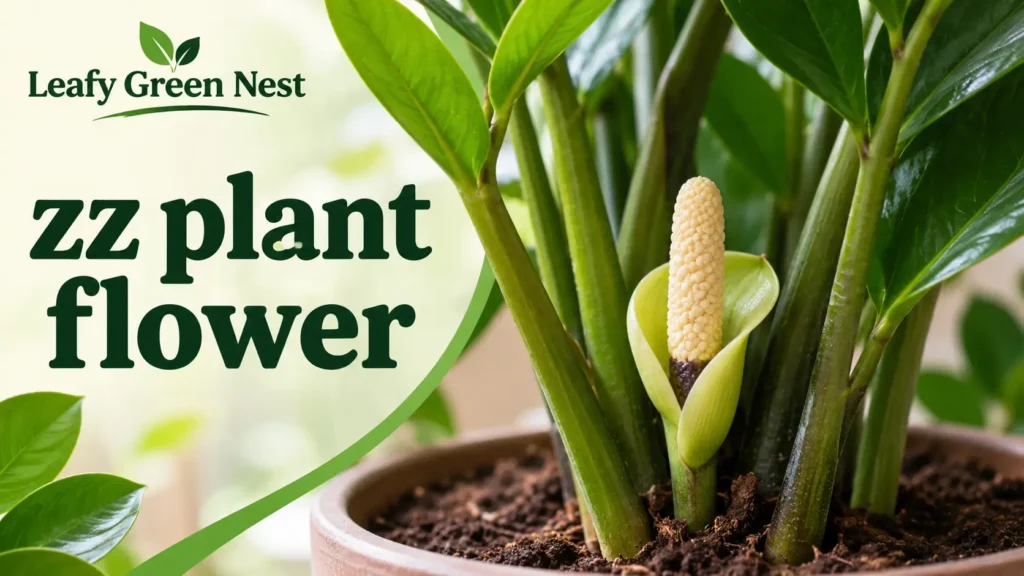
A ZZ plant flower is a small, pale green or cream-colored bloom that grows near the base of a ZZ plant (Zamioculcas zamiifolia). Unlike roses or lilies, it does not have bright petals or a strong scent. In fact, you might own a ZZ plant for years without ever noticing a flower.
Here’s something interesting: the ZZ plant is famous for its shiny green leaves, but it can flower, too. Its blooms are just easy to miss because they grow close to the soil, often hidden between the stems.
The flower has two main parts:
- Spathe: A green, leaf-like cover that surrounds the flower.
- Spadix: A short, fleshy spike covered with tiny individual flowers.
Both parts are common in plants from the Araceae family. Peace lilies and anthuriums have a similar flower structure, although their blooms are much easier to spot.
We often think of flowering as a sign that a plant is doing well. With a ZZ plant, that’s an interesting bonus, but don’t worry if yours never blooms. Its beautiful leaves are reason enough to keep it around.
Table of Contents
Does ZZ Plant Flower Indoors?
Yes, a ZZ plant can flower indoors, but it does not happen very often. Mature plants have a better chance of producing flowers when they receive enough light, warmth, and proper care.
Imagine keeping a ZZ plant in a dim bedroom corner. It may grow slowly, hold its glossy leaves, and look perfectly happy. However, that same plant might never produce a flower because the light is too weak.
Here are some factors that affect flowering:
- Age: Young plants need time to develop before they can flower.
- Light: Bright, indirect sunlight supports healthy growth.
- Temperature: Warm conditions help the plant grow actively.
- Nutrition: A healthy growing medium supports normal development.
- Watering: Too much water can damage the roots and underground rhizomes.
The University of Florida’s IFAS Extension explains that ZZ plants are well suited to indoor growing but generally do not flower in low-light conditions.
So, if your ZZ plant has never bloomed, don’t panic. A plant can be perfectly healthy without producing a single flower.
ZZ Plant Flower Appearance: What Does It Look Like?
A ZZ plant flower looks more like a tiny green structure than a traditional flower. It grows near the soil instead of sitting proudly at the top of a long stem.
Once you know what to look for, it becomes much easier to recognize.
The Spathe
The spathe is the outer covering of the flower. It usually looks pale green or yellowish-green, almost like a small leaf folded around the central part.
Think of it as a protective jacket around the tiny flowers.
The Spadix
The spadix is the fleshy structure inside the spathe. It contains many tiny flowers arranged along its surface.
It can look cream-colored, pale yellow, or slightly brown as it develops.
Where Does the Flower Grow?
This is where things get interesting. Unlike a sunflower that grows high above its leaves, the ZZ plant flower appears close to the soil.
It often develops between the plant’s thick stems, which makes it easy to overlook.
A useful identification tip: A new leaf shoot grows into a leafy stem, while a flower develops a spathe surrounding a fleshy spadix. Don’t mistake every new green growth for a flower.
ZZ Plant Flower Benefits: Why Is It Special?
The ZZ plant flower has botanical, decorative, and symbolic value, but there is no proven medicinal benefit from the flower itself. The plant is mainly appreciated for its attractive appearance and easy care.
Let’s look at why people find this unusual bloom interesting.
It Makes Your Plant Collection More Interesting
Most people buy ZZ plants for their thick stems and shiny leaves. Seeing a flower is an unexpected bonus.
For someone who enjoys collecting houseplants, a flowering ZZ plant can be a special sight.
It Shows Reproductive Growth
A flower is part of the plant’s natural reproduction process. Its appearance means the plant has developed an inflorescence.
It’s a little like watching a plant reach a new stage of life.
It Helps You Learn About Plants
ZZ plants belong to the Araceae family, which also includes peace lilies, anthuriums, philodendrons, and monsteras.
These plants share a similar flower structure, with a spathe and spadix. Looking closely at a ZZ flower is a simple way to understand how these plants reproduce.
It Adds Symbolic Meaning
Some people connect ZZ plants with good luck, financial growth, and abundance. A rare flower may carry an extra meaning of fresh opportunities and progress.
These are cultural beliefs, not scientifically proven effects.
One thing worth remembering: A ZZ plant is not a magic air cleaner. Research on indoor plants does not show that ordinary potted plants can replace proper ventilation or air filters.
ZZ Plant Flower Meaning: What Does It Symbolize?
A ZZ plant flower is often linked to good luck, prosperity, patience, and fresh beginnings. These meanings come from the plant’s strong growth and ability to survive when other houseplants struggle.
Think about it. You might forget to water your ZZ plant for a while, and it still manages to look fresh and green. That’s one reason people connect it with strength and resilience.
Here are some popular meanings:
- Good fortune: A blooming ZZ plant is sometimes seen as a sign of good luck.
- New beginnings: A flower can represent a fresh start or a new chapter in life.
- Wealth and abundance: Its shiny green leaves are often linked with financial growth.
- Patience: The plant grows slowly, reminding us that good things take time.
- Strength: Its ability to handle dry conditions makes it a symbol of resilience.
There is no official or universal meaning for the ZZ plant flower. These ideas are based on cultural beliefs rather than scientific facts.
ZZ Plant Flower Meaning Spiritual: Is It a Good Sign?
Yes, many people consider a ZZ plant flower a positive spiritual sign because it represents growth, hope, and unexpected blessings. Its rare appearance makes it feel extra special to people who enjoy plant symbolism.
Imagine caring for the same plant for years and suddenly spotting a tiny flower near the soil. It can feel like a lovely little surprise!
Some common spiritual interpretations include:
- Positive changes: A reminder that better days may be ahead.
- Personal growth: A symbol of becoming stronger and wiser.
- Unexpected blessings: A sign of hope and new opportunities.
- Inner strength: A reminder to stay strong during difficult times.
- Abundance: A symbol of success and financial stability.
I would treat these meanings as a source of inspiration rather than a promise about the future. A flower cannot predict what will happen in your life, but it can certainly make an ordinary day feel special.
ZZ Plant Flower Feng Shui: Where Should You Place It?
In Feng Shui, ZZ plants are often connected with wealth, success, and positive energy. People commonly place them in living rooms, offices, and areas they associate with prosperity.
Here are some popular placement ideas:
Wealth corner: The southeast area of a home is traditionally linked with wealth and abundance in Feng Shui. Some people place a ZZ plant there to represent financial growth.
Office: A healthy ZZ plant looks lovely beside a desk or in an office corner. Its upright stems are often seen as a symbol of progress and success.
Living room: Place it in a bright corner where its glossy leaves can add a fresh touch to the space.
Entrance: Some people keep a ZZ plant near the entrance to symbolize welcoming good opportunities.
One practical fact matters more than the placement: ZZ plants tolerate low light, but they grow better in bright, indirect light. So, choose a spot that works for both your home and your plant.
How to Make a ZZ Plant Flower Naturally
You cannot force a ZZ plant to flower, but you can give it the right conditions to grow well. Bright, indirect light, warm temperatures, healthy roots, and careful watering are good starting points.
Let’s look at what you can do at home.
Give It Bright, Indirect Light
Place your plant near a bright window where sunlight is filtered. An east-facing window is often a good choice.
Avoid leaving it under strong afternoon sunlight. Too much direct sun can burn the leaves and leave ugly brown patches.
Choose the Right Soil
ZZ plants need soil that drains well. Their underground rhizomes store water, so soggy soil can cause trouble.
A simple potting mix can include:
- Two parts indoor potting soil.
- One part perlite.
- One part orchid bark.
The goal is to keep the soil loose so extra water can escape.
Water Only When Needed
Don’t water your ZZ plant just because the top of the soil looks a little dry. Check the soil deeper down first.
If it is still damp, wait a few more days. If it has dried out, water thoroughly and let the extra water drain away.
The North Carolina State University Extension recommends allowing the potting soil to dry between waterings because ZZ plants do not tolerate constantly wet roots.
Keep It Warm
ZZ plants prefer warm indoor conditions. A temperature of around 18°C to 32°C is generally suitable.
Keep your plant away from cold windows, chilly air conditioners, and sudden temperature changes.
Feed It Carefully
A balanced houseplant fertilizer can support healthy growth during the warmer months.
You don’t need to feed it every week. ZZ plants grow slowly and are not heavy feeders, so too much fertilizer can do more harm than good.
Be Patient
This is the part many plant owners find difficult!
You may provide excellent care and still see no flowers. That’s normal. Enjoy the new leaves, keep the roots healthy, and let the plant grow at its own pace.
ZZ Plant Flower Rare: Why Is It So Uncommon?
ZZ plant flowers are rare in homes because indoor conditions often do not provide everything the plant needs to bloom. Mature plants grown in suitable light and warm conditions have a better chance of flowering.
There are a few simple reasons behind this.
Not enough light: A ZZ plant can survive in a dark corner, but it may not flower there.
Young age: A young plant usually spends its energy developing leaves and underground rhizomes.
Slow growth: ZZ plants are naturally slow growers, so flowering may take a long time.
Indoor conditions: Temperature, light, and seasonal changes can affect flowering.
According to the University of Florida IFAS Extension, mature ZZ plants may flower during spring and early summer when they receive sufficient light. Their flowers appear just above the soil.
So, don’t feel disappointed if your plant never blooms. A healthy ZZ plant with beautiful leaves is already doing a great job.
ZZ Plant Flower Seeds: Can You Grow a New Plant?
Yes, a ZZ plant can produce seeds after successful pollination, but this is not a common sight in indoor plants. The female flowers may develop into small fruits containing seeds.
The plant has separate male and female flowers on the same spadix. Female flowers are generally found toward the lower part, while male flowers grow above them.
After pollination, the female flowers may develop into fruits.
However, growing a ZZ plant from seeds is not the easiest option for home gardeners.
Here are more practical ways to grow another plant:
- Rhizome division: Separate a healthy section of the underground rhizome with roots and shoots.
- Leaf cutting: Use a healthy leaf and place its base in a suitable growing medium.
- Stem cutting: Take a healthy stem cutting and allow it to develop roots and a rhizome.
One thing to remember is that ZZ plant propagation can be slow. The University of Connecticut’s Home Garden Education Center notes that developing a rhizome from a leaf cutting can take several months under normal indoor conditions.
If you want a new ZZ plant, rhizome division is usually the quickest practical choice.
Should You Remove a ZZ Plant Flower?
No, you don’t need to remove a ZZ plant flower because it is a natural part of the plant’s growth. You can leave it alone unless it becomes damaged or starts to decay.
Some people prefer removing old flowers to keep the plant looking neat. Others simply let nature take its course.
If you decide to remove it:
- Use clean, sharp scissors.
- Cut the flower stalk close to its base.
- Avoid cutting nearby leaves or stems.
- Wear gloves when handling the plant.
- Wash your hands after pruning.
There is no need to remove a healthy flower just to help the plant grow new leaves.
Is the ZZ Plant Flower Poisonous?
Yes, the ZZ plant contains calcium oxalate crystals that can cause irritation if parts of the plant are chewed or swallowed. This includes the leaves, stems, and flower structures.
These tiny, needle-shaped crystals can irritate the mouth and digestive system.
Possible signs of exposure include:
- Burning in the mouth.
- Irritated lips and tongue.
- Drooling.
- Difficulty swallowing.
- Nausea or vomiting.
The American Society for the Prevention of Cruelty to Animals (ASPCA) lists the ZZ plant among houseplants that can cause problems for pets because of their insoluble calcium oxalate crystals.
If you have cats or dogs at home, keep the plant somewhere they cannot reach. If a pet chews it, contact a veterinarian for advice.
For children, seek medical advice if any part of the plant is swallowed. Serious swelling or breathing difficulties need urgent medical attention.
Common ZZ Plant Flower Problems and Mistakes
Most ZZ plant problems come from too much water, poor drainage, or unsuitable light. These mistakes can affect the plant’s health, even if you are trying your best to encourage flowering.
Here are some common mistakes and easy ways to avoid them.
| Mistake | What can happen | What to do instead |
|---|---|---|
| Watering too often | Roots may rot | Let the soil dry between watering |
| Strong direct sunlight | Leaves may burn | Choose filtered light |
| Poor drainage | Soil stays wet | Use a pot with drainage holes |
| Too much fertilizer | Roots may become damaged | Feed sparingly |
| Cold conditions | Growth may slow | Keep the plant warm |
| Expecting regular flowers | Unnecessary worry | Enjoy its natural growth |
The Clemson Cooperative Extension’s ZZ plant care guide also recommends well-draining soil and careful watering. Its advice is especially useful if you tend to give your houseplants a little too much attention!
A simple routine is best. Check the soil, look at the leaves, and avoid changing the plant’s location too often.
A Rare Bloom Worth Appreciating
A ZZ plant flower may be small and easy to miss, but it is still a lovely surprise for anyone who enjoys growing houseplants. Its unusual shape, rare appearance, and interesting symbolism make it worth noticing.
If your plant flowers, enjoy the moment! Give it bright, indirect light, well-draining soil, and careful watering. And if it never blooms, don’t worry. Those shiny green leaves are already doing their thing.
Frequently Asked Questions About ZZ Plant Flowers
Does a ZZ plant flower every year?
No, ZZ plants do not flower every year. Indoor flowering is uncommon, and some mature plants may go many years without producing a flower.
What does a ZZ plant flower symbolize spiritually?
It is often associated with good luck, prosperity, patience, strength, and new beginnings. These meanings come from cultural and spiritual beliefs, not scientific evidence.
Can a ZZ plant flower produce fruit?
Yes, successful pollination can allow female flowers to develop into small fruits containing seeds. However, this rarely happens in ordinary indoor conditions.
Is a flowering ZZ plant healthy?
Flowering can show that a plant has reached reproductive maturity. However, check its leaves, stems, roots, and soil too, because a flower alone does not prove that the entire plant is healthy.
When does a ZZ plant usually flower?
ZZ plants may flower during spring or early summer when growing conditions are suitable. Indoor plants do not always follow a regular flowering season.
Why is my ZZ plant growing leaves but no flowers?
This is completely normal. ZZ plants are mainly grown for their foliage, and indoor light levels may support leaf growth without encouraging flowering.


