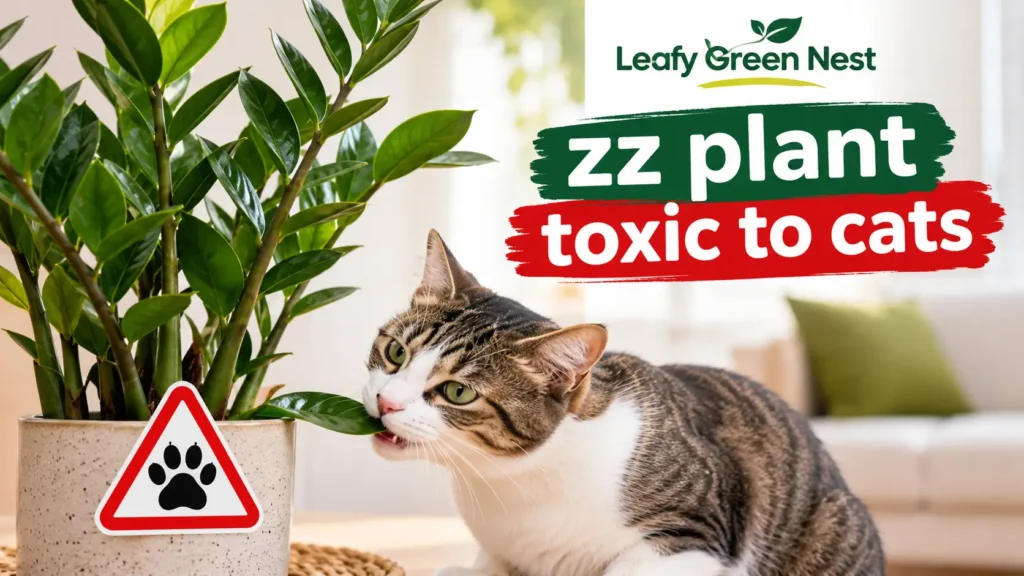
A ZZ plant may look like the perfect low-maintenance houseplant, but there is one thing every cat owner should know: a ZZ plant is toxic to cats if they chew or swallow it. Even a small bite can irritate a cat’s mouth and stomach, which is why understanding ZZ plant toxic to cats symptoms is so important.
The good news is that most cases cause irritation rather than severe poisoning. Still, knowing the warning signs, what to do after a bite, and how to prevent exposure can help protect your pet.
In this article, we’ll explain why the ZZ plant is toxic to cats, whether it is also toxic to dogs and humans, and if the popular Raven ZZ variety carries the same risk.
Table of Contents
What Is a ZZ Plant?
The ZZ plant is a popular indoor plant known for its glossy green leaves and ability to handle low light. Its scientific name is Zamioculcas zamiifolia. People often choose it because it needs little water and does not demand much attention.
A tough plant for busy homes, but not a safe snack for pets.
ZZ plants grow from thick underground stems called rhizomes. These store water, which helps the plant survive when the soil gets dry. Its smooth, shiny leaflets grow along upright stems, giving it a neat, full appearance.
You may see ZZ plants in:
- Living rooms and bedrooms
- Office desks and reception areas
- Hallways and shaded corners
- Shops, cafés, and other indoor spaces
Their easy-care nature makes them tempting to bring home. But if you have a cat that chews leaves, the plant needs extra care.
Key Takeaways
Remember these points before placing a ZZ plant in a home with pets.
- ZZ plants contain insoluble calcium oxalate crystals that irritate the mouth and digestive tract.
- Cats may drool, paw at their mouths, vomit, or refuse food after chewing the plant.
- Dogs can also react to ZZ plant exposure.
- Raven ZZ is a variety of the same plant species and should be treated as toxic too.
- Skin contact is usually less concerning than chewing or swallowing the plant, but sap may irritate sensitive skin.
- Contact a veterinarian if your pet eats any part of the plant.
Why Is ZZ Plant Toxic to Cats?
ZZ plants are toxic to cats because they contain tiny, needle-shaped crystals called insoluble calcium oxalates. These crystals can irritate the tissues inside a cat’s mouth and digestive system.
Think of the crystals like very fine splinters. When a cat bites a leaf, the crystals can get into the mouth and cause immediate discomfort. The irritation may continue as the plant material moves through the digestive tract.
This is different from poisoning caused by a chemical that gets absorbed into the bloodstream and affects organs. With ZZ plants, the main problem is usually local irritation.
A cat may bite a leaf out of curiosity, especially if it hangs over the edge of a pot. Some cats also chew plants when they are bored or enjoy the texture.
Does a small bite matter? Yes. A small bite may cause mild irritation, but the reaction depends on how much the cat chews and the individual animal. Do not assume a small amount is harmless.
Are All Parts of a ZZ Plant Toxic to Cats?
You should treat every part of a ZZ plant as unsafe for cats to chew or swallow. That includes the leaves, stems, and underground rhizomes.
The plant’s calcium oxalate crystals are the reason for concern. A cat does not need to eat a large piece of the plant to experience irritation.
| Plant part | Risk for cats |
|---|---|
| Leaves | Can irritate the mouth if chewed |
| Stems | Should not be chewed or swallowed |
| Rhizomes | Should be kept away from pets |
| Broken leaves and clippings | Can still cause irritation |
| Plant sap | May irritate sensitive skin or tissues |
Keep fallen leaves and pruning waste out of reach. A leaf that drops onto the floor can look like an easy toy to a curious cat.
ZZ Plant Toxic to Cats Symptoms
The most common ZZ plant toxic to cats symptoms involve the mouth and stomach. They may appear soon after a cat chews the plant.
Watch for these signs:
- Drooling: Your cat may produce more saliva than usual.
- Pawing at the mouth: Your cat may rub its face or mouth with its paws.
- Mouth irritation: The lips, tongue, or gums may become painful or irritated.
- Vomiting: Your cat may throw up after swallowing plant material.
- Reduced appetite: Mouth pain can make eating uncomfortable.
- Difficulty swallowing: Irritation or swelling may make swallowing harder.
A serious warning sign
Difficulty breathing, marked swelling around the mouth or throat, collapse, or severe weakness needs urgent veterinary attention. These signs are not typical of a mild exposure, but you should never wait to see if they pass.
Not every cat will show every symptom. Some may only drool or paw at their mouths. Others may vomit or refuse food.
If you are unsure whether your cat has chewed a ZZ plant, look for fresh bite marks, missing leaf tips, or pieces of plant material near the pot.
What to Do if Your Cat Eats a ZZ Plant
If your cat chews a ZZ plant, move the plant away and contact your veterinarian for advice. Do not wait for symptoms if you know your cat swallowed part of it.
Follow these steps:
- Move your cat away from the plant. Put the pot somewhere your pet cannot reach.
- Remove visible plant pieces. If you can safely see a leaf fragment in your cat’s mouth, remove it gently. Do not force your cat’s mouth open.
- Wipe away plant residue. If your cat allows it, gently wipe the mouth with a damp cloth. Do not risk being bitten.
- Call your veterinarian. Explain what happened, when it happened, and how much your cat may have eaten.
- Take a photo of the plant. This can help your vet confirm what your cat chewed.
- Watch for symptoms. Look for drooling, pawing at the mouth, vomiting, reduced appetite, or trouble swallowing.
Do not make your cat vomit. Do not give medication or home remedies unless a veterinary professional tells you to. If your cat has trouble breathing or swallowing, go to an emergency veterinary clinic immediately.
The ASPCA explains that ZZ plants are among the houseplants that can irritate pets when chewed. Its advice also highlights the importance of contacting a veterinarian or poison-control service after a suspected exposure. You can read its guide to houseplants that can cause trouble for pets. ASPCA+1
Is ZZ Plant Toxic to Dogs?
Yes. ZZ plants should also be kept away from dogs because chewing them can cause mouth and stomach irritation.
Dogs may be tempted to investigate a plant with their nose or teeth. Puppies are especially likely to chew objects around the home, but adult dogs can do it too.
Possible signs after chewing a ZZ plant include:
- Drooling or licking the lips repeatedly
- Pawing at the mouth
- Vomiting or retching
- Loss of appetite
- Diarrhea or stomach discomfort
The reaction can vary from one dog to another. The amount swallowed, the dog’s size, and its general health can all affect how the exposure develops.
If your dog eats part of a ZZ plant, follow the same steps you would for a cat: remove access, keep a photo of the plant, and call your veterinarian. Do not assume your dog is safe just because it seems normal at first.
ZZ Plant Toxic to Cats ASPCA: What Does the Listing Mean?
The ASPCA identifies ZZ plant as a potentially harmful houseplant for pets. Its article names ZZ plant under Zamioculcas and explains that the plant contains needle-like crystals that can cause irritation when chewed.
These crystals are called raphides. They can cause pain in the mouth and throat, leading to drooling, retching, nausea, vomiting, and reduced appetite. In rare cases, serious swelling can make breathing difficult. ASPCA
One detail can cause confusion: the ASPCA’s general plant database and its articles do not always present information in the same way. A plant not appearing in a particular search result should not be treated as proof that it is safe.
For another useful veterinary explanation, the Merck Veterinary Manual describes how insoluble oxalate crystals in certain plants cause immediate irritation and why supportive care may be needed. The Pet Poison Helpline also explains the symptoms linked to insoluble oxalates. Merck Veterinary Manual+1
Is Raven ZZ Plant Toxic to Cats?
Yes. Raven ZZ should be treated as toxic to cats, just like the regular green ZZ plant.
Raven ZZ is a dark-leaved variety of Zamioculcas zamiifolia. Its leaves are deep purple to almost black, which gives it a different look from the familiar bright-green plant.
The color change does not make it pet-safe. It is still a ZZ plant, so cat owners should treat it as a chewing risk.
The same rule applies to other ZZ varieties sold by plant shops. A different leaf color or plant label does not mean the plant has different pet-safety properties.
Is ZZ Plant Toxic to Humans?
A ZZ plant can irritate people if they chew or swallow it. It is not a plant to eat, and children should not be allowed to put its leaves or stems in their mouths.
The calcium oxalate crystals can cause an uncomfortable reaction in the mouth and digestive tract. If someone chews the plant, possible effects include:
- Burning or irritation in the mouth
- Pain or discomfort when swallowing
- Nausea
- Vomiting or diarrhea, especially after eating more plant material
The risk from accidental skin contact is generally lower than the risk from chewing the plant. Still, wash your hands after pruning or handling damaged leaves, and keep sap away from your eyes and mouth.
If a child or adult swallows part of the plant, contact a medical professional or local poison information service for advice. Seek urgent help for breathing problems, severe swelling, or difficulty swallowing.
Is ZZ Plant Poisonous to Touch?
Simply touching an intact ZZ plant is not usually a cause for serious concern. The main risk comes from chewing or swallowing the plant, although sap from a damaged leaf may bother sensitive skin.
For everyday plant care, a few simple habits are enough:
- Wear gardening gloves when pruning or repotting.
- Wash your hands after handling broken leaves or stems.
- Avoid rubbing your eyes while working with the plant.
- Clean up fallen leaves and plant pieces.
- Keep pruning tools away from children and pets.
If sap gets on your skin, wash the area with soap and water. If you develop a rash or ongoing irritation, stop handling the plant and seek medical advice.
North Carolina State University’s Extension plant database lists calcium oxalate as the ZZ plant’s toxic principle. It also describes the plant as a problem for cats and dogs and notes that eating the leaves can cause symptoms in people. North Carolina Extension Gardener Plant Toolbox
Is Snake Plant Toxic to Cats Too?
Yes. Snake plants are toxic to cats, but they contain a different irritating substance from ZZ plants.
The snake plant, now commonly called Dracaena trifasciata, contains compounds called saponins. According to the ASPCA, eating the plant can cause nausea, vomiting, and diarrhea in cats and dogs. ASPCA+1
Here is a simple comparison:
| Feature | ZZ plant | Snake plant |
|---|---|---|
| Scientific name | Zamioculcas zamiifolia | Dracaena trifasciata |
| Main concern | Insoluble calcium oxalate crystals | Saponins |
| Common cat symptoms | Mouth pain, drooling, vomiting | Nausea, vomiting, diarrhea |
| Safe for cats to chew? | No | No |
Neither plant is a good choice if your cat likes to nibble leaves. A plant being easy to care for does not mean it is safe for pets.
Pet-Friendly Plants to Consider Instead
If you love indoor greenery but worry about your cat, consider plants listed as non-toxic to cats by a reliable pet-safety source. Always check the exact plant name before buying because common names can refer to different species.
Some options often chosen for pet-friendly homes include:
- Parlor palm: A small palm that works well indoors.
- Spider plant: An easy-care plant with long, arching leaves.
- Boston fern: A leafy plant that adds a soft, full look.
- Peperomia: A compact plant available in several leaf shapes and colors.
Even non-toxic plants can cause mild stomach upset if a cat eats a lot of them. Keep an eye on your pet and avoid letting it treat houseplants as food.
How to Keep Cats Away From ZZ Plants
The safest option is to keep a ZZ plant out of any area your cat can reach. A high shelf may look like a good solution, but cats can jump, climb, and knock pots over.
Try these practical steps:
- Choose a closed room. Keep the plant in a room your cat cannot enter.
- Use stable shelves. Do not place heavy pots where they can fall.
- Clean up fallen leaves. Remove plant debris as soon as you notice it.
- Offer cat grass. Some cats enjoy chewing safe grasses, which may give them another option to explore.
- Use barriers where needed. A secure plant cabinet can help protect both the plant and your pet.
Avoid relying on strong-smelling sprays or homemade mixtures. Some substances used as deterrents can irritate pets or create another safety problem.
Common Mistakes Cat Owners Should Avoid
A few everyday assumptions can put pets at risk. Avoid these mistakes when you keep houseplants.
- Assuming a small bite is harmless: Even a small amount can cause irritation.
- Trusting the plant’s appearance: A dark-leaved Raven ZZ is not safer than a green ZZ.
- Waiting for symptoms: Contact your vet when you know your cat has eaten the plant.
- Making your cat vomit: This can cause further harm and should only be done if a vet specifically instructs you.
- Checking only the common name: Use the scientific name to confirm the plant’s identity.
If you have several plants at home, make a list of their scientific names. It is much easier to check plant safety before an emergency than during one.
ZZ Plant Safety: What Every Cat Owner Should Remember
ZZ plants are attractive, easy to grow, and popular in homes. But they are not safe for cats to chew.
The plant contains insoluble calcium oxalate crystals that can irritate a cat’s mouth and digestive system. Drooling, mouth pain, vomiting, and reduced appetite are common warning signs. Dogs and people can also experience irritation if they chew or swallow the plant.
Raven ZZ is not a safer alternative because it belongs to the same plant species. Snake plants are also unsafe for cats, although they contain saponins rather than calcium oxalate crystals.
If your cat eats any part of a ZZ plant, remove access to the plant and contact your veterinarian. Do not wait for symptoms or try to make your cat vomit.
You can still enjoy indoor plants while protecting your pet. Choose plants confirmed as non-toxic to cats, check scientific names before buying, and keep potentially harmful plants out of reach.
Frequently Asked Questions About ZZ Plants and Cats
These quick answers cover common questions cat owners ask before bringing a ZZ plant home.
Can a ZZ plant kill a cat?
Severe reactions are uncommon, but serious swelling in the throat can make breathing difficult. Most cases involve mouth irritation and stomach upset. Contact a vet after any known ingestion.
How much ZZ plant is toxic to cats?
There is no reliable safe amount. Even a small bite can cause mouth irritation. The reaction depends on the amount eaten and the individual cat.
Does ZZ plant toxicity cause kidney damage in cats?
The main concern with insoluble calcium oxalate crystals is local irritation in the mouth and digestive tract. This is different from soluble oxalate poisoning, which can affect the kidneys.
Should I take my cat to the vet after one bite?
Yes, call your veterinarian for advice, even if your cat seems fine. Seek emergency care if your cat has trouble breathing, swallowing, or shows severe swelling.
Is a ZZ plant safe for cats if it is kept on a high shelf?
Not necessarily. Cats can jump onto shelves and knock pots over. A closed room or secure plant cabinet is a safer choice than relying on height alone.
When should I worry about ZZ plant poisoning?
Take it seriously if your cat starts drooling, pawing at its mouth, vomiting, or refusing food. Breathing difficulty, severe swelling, or trouble swallowing requires emergency care.