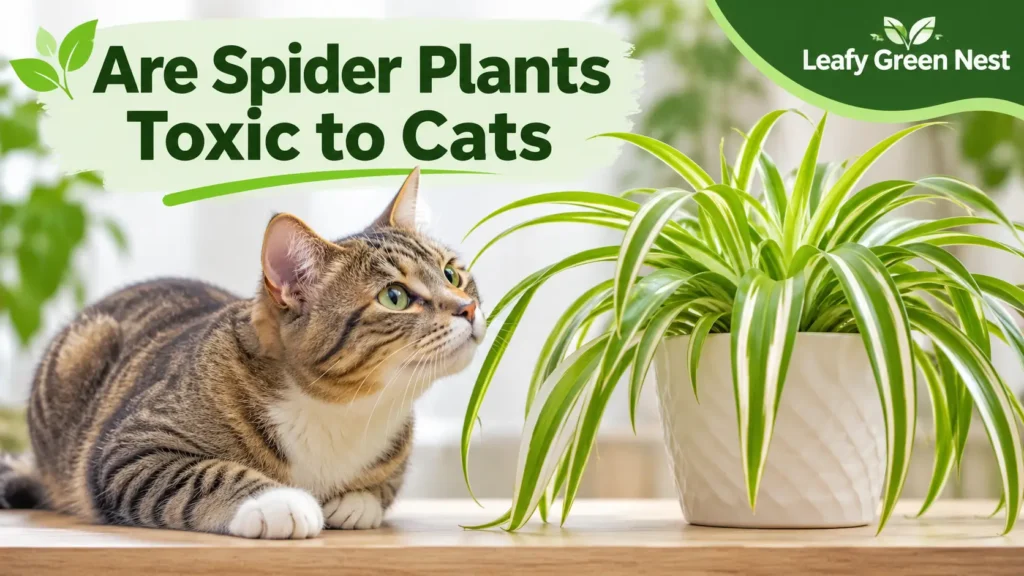
Are spider plants toxic to cats? No, spider plants are considered non-toxic to cats and dogs by the American Society for the Prevention of Cruelty to Animals (ASPCA). Their scientific name is Chlorophytum comosum, and they are popular indoor plants because they are attractive, affordable, and easy to grow.
Spider plants have long, narrow leaves that arch outward from the center. Their dangling leaves and small baby plants can attract curious cats that enjoy playing with or chewing greenery.
Although spider plants are not considered poisonous, eating large amounts of plant material may still upset your cat’s stomach. Understanding the difference between plant toxicity and digestive irritation can help you make safer choices for your pet.
Table of Contents
Key Takeaways About Spider Plant Toxicity in Cats
Spider plants are generally safe to keep in homes with cats, but excessive chewing should still be discouraged. Here are the most important facts to remember.
- Spider plants are classified as non-toxic to cats by the ASPCA.
- Their botanical name is Chlorophytum comosum.
- Eating large amounts of leaves may cause mild digestive upset.
- Spider plants are also considered non-toxic to dogs.
- There is no established scientific evidence that spider plants cause hallucinations in cats.
- Snake plants are toxic to cats and should not be confused with spider plants.
- Cat grass can provide an alternative for pets that enjoy chewing greenery.
Are Spider Plants Toxic to Cats According to ASPCA?
The ASPCA lists Chlorophytum comosum as non-toxic to cats and dogs. This means the plant is not known to contain toxins that cause systemic poisoning in these animals.
Spider plants are therefore a suitable option for many pet-owning households. However, non-toxic does not mean that cats should eat unlimited amounts of their leaves.
The ASPCA also explains that consuming plant material, including non-toxic varieties, can cause vomiting and gastrointestinal upset in cats and dogs.
For example, if your cat chews several long spider plant leaves, the fibrous material may irritate its digestive system. Your pet might vomit or experience temporary stomach discomfort.
This reaction does not automatically mean your cat has been poisoned.
One important precaution: Always identify a plant by its scientific name. Some common plant names are used for multiple species, and their toxicity levels can be very different.
Are Spider Plants Toxic to Dogs?
No, true spider plants are also considered non-toxic to dogs. The ASPCA includes Chlorophytum comosum in its non-toxic plant listings for both cats and dogs.
However, dogs can experience digestive discomfort after eating too much plant material. Possible reactions include:
- Vomiting
- Mild diarrhea
- Temporary stomach discomfort
- Reduced appetite
If your dog eats a small amount of spider plant leaves and behaves normally, serious poisoning is not expected. Contact your veterinarian if your dog develops repeated vomiting, persistent diarrhea, or unusual weakness.
Are Spider Plants Toxic to Cats and Dogs? Symptoms to Watch For
Spider plants are considered non-toxic to both cats and dogs, but eating large quantities can still cause gastrointestinal irritation. Individual reactions depend on the amount consumed and the animal’s sensitivity.
Here are some possible signs to monitor after your pet chews a spider plant.
| Symptom | Possible Explanation |
|---|---|
| Vomiting | Digestive irritation after eating plant material |
| Diarrhea | Gastrointestinal upset |
| Reduced appetite | Temporary stomach discomfort |
| Drooling | Mouth irritation or another problem |
| Retching | Reaction to chewing fibrous leaves |
| Unusual tiredness | May indicate another health problem |
These symptoms are not specific to spider plants. They can also occur after exposure to other plants, household chemicals, or unrelated illnesses.
An isolated episode of vomiting may be mild, but repeated vomiting, ongoing diarrhea, weakness, or refusal to eat should be discussed with a veterinarian.
If your cat develops difficulty breathing, collapses, or becomes severely weak, seek emergency veterinary care.
Spider Plants Cats High: Do They Cause Hallucinations?
Some cat owners believe spider plants produce effects similar to catnip. Online discussions often describe cats becoming unusually playful, excited, or interested after chewing their leaves.
However, there is no convincing scientific evidence establishing that spider plants cause hallucinations or a drug-like reaction in cats.
Several factors may explain why cats seem attracted to these plants:
- Their long leaves move easily and attract playful cats.
- Dangling foliage can trigger natural hunting instincts.
- Some cats enjoy exploring different plant textures.
- Curiosity may encourage repeated sniffing and chewing.
- Owners may mistake normal playful behavior for a chemical reaction.
Spider Plants vs. Catnip
Spider plants and catnip are two different plant species with different characteristics. Catnip contains nepetalactone, a compound that can trigger temporary behavioral responses in many cats.
The ASPCA lists catnip as toxic to cats because it can cause vomiting and diarrhea, although many cats also show temporary excitement or sedation after exposure.
Spider plants do not have an established equivalent effect.
| Feature | Spider Plant | Catnip |
|---|---|---|
| Scientific name | Chlorophytum comosum | Nepeta cataria |
| ASPCA classification | Non-toxic | Listed as toxic |
| Associated compound | No established catnip-like compound | Nepetalactone |
| Can attract cats? | Yes | Yes |
| Can cause temporary behavioral changes? | Not scientifically established | Yes |
| Known toxicity concern | Possible digestive upset from plant material | Vomiting and diarrhea |
The important distinction is that a cat’s interest in a spider plant does not prove that the plant makes it high.
Are Snake Plants Toxic to Cats? Important Differences
Yes, snake plants are toxic to cats and dogs. Despite their similar common names, snake plants and spider plants are completely different species.
Snake plants were traditionally known as Sansevieria trifasciata. Their accepted botanical name is Dracaena trifasciata.
Unlike spider plants, snake plants contain saponins that can cause gastrointestinal problems when consumed.
Possible symptoms include:
- Nausea
- Vomiting
- Diarrhea
- Drooling
- Reduced appetite
If your cat eats part of a snake plant, contact your veterinarian for advice.
Spider Plant vs. Snake Plant
| Feature | Spider Plant | Snake Plant |
|---|---|---|
| Scientific name | Chlorophytum comosum | Dracaena trifasciata |
| Toxic to cats? | No | Yes |
| Toxic to dogs? | No | Yes |
| Main concern | Digestive upset after eating plant material | Saponin-related gastrointestinal symptoms |
| Pet-friendly classification | Non-toxic | Toxic |
Never identify a houseplant using its common name alone. Checking its scientific name can prevent dangerous mistakes.
What Should You Do If Your Cat Eats a Spider Plant?
If your cat has eaten spider plant leaves, stay calm and prevent further chewing. Because the plant is classified as non-toxic, a small bite is generally not a poisoning emergency.
Follow these steps to protect your pet.
Remove the plant.
Move the spider plant somewhere your cat cannot reach. This prevents your pet from eating additional leaves.
Check how much your cat ate.
Look at the plant and estimate whether your cat chewed a small leaf tip, swallowed one or two leaves, or consumed a larger amount.
Identify the plant.
Confirm that it is actually Chlorophytum comosum. If you are unsure, take a photograph and ask your veterinarian to help identify it.
Monitor your cat.
Watch for vomiting, diarrhea, drooling, reduced appetite, or unusual behavior. Pay attention to whether your pet continues eating, drinking, and behaving normally.
Contact your veterinarian when necessary.
Seek veterinary advice if symptoms develop or your cat eats a large amount. Repeated vomiting, persistent diarrhea, weakness, or refusal to eat should not be ignored.
Never try to make your cat vomit at home unless a veterinarian specifically instructs you to do so.
How to Keep Cats Away From Spider Plants
Even though spider plants are non-toxic, preventing excessive chewing is better for your pet and your plant. A few simple changes can make indoor gardening easier for cat owners.
Use Hanging Plant Baskets
Hanging baskets can reduce your cat’s access to spider plant leaves. Make sure the basket is securely attached and positioned where your cat cannot jump onto it.
Provide Cat Grass
Cat grass is a popular alternative for cats that enjoy chewing greenery. It commonly includes young wheat, oat, barley, or rye grass.
Place a small pot somewhere accessible to encourage your cat to explore an alternative.
Choose a Safe Plant Location
Place spider plants on stable shelves or in rooms your cat cannot access. Avoid unstable furniture where a jumping cat could knock the pot over.
Avoid Harmful Repellents
Do not use essential oils, chemical sprays, or homemade mixtures without checking their safety for cats. Some substances used in household plant care can be harmful to pets.
Keep Your Cat Entertained
Provide scratching posts, climbing areas, toys, and interactive play sessions. These activities can help redirect your cat’s attention away from houseplants.
For more advice about why cats chew household plants and how to manage the behavior, read the Cornell Feline Health Center’s guide to destructive behavior.
Common Mistakes Cat Owners Should Avoid
Even with a non-toxic plant, a few common mistakes can create unnecessary risks. Understanding these mistakes helps you protect your pet and maintain a safer home.
- Assuming non-toxic means edible: Spider plants are decorative houseplants, not a regular food source for cats.
- Ignoring repeated vomiting: Frequent vomiting may indicate a problem that requires veterinary attention.
- Confusing spider plants with snake plants: These species have very different toxicity classifications.
- Trusting every online claim: Social media experiences are not a substitute for reliable veterinary information.
- Forgetting about gardening chemicals: Fertilizers, pesticides, and other products may create additional risks for pets.
- Allowing unrestricted chewing: Even non-toxic plants should not become your cat’s regular snack.
Keep a record of the plants in your home so you can identify them quickly if your cat chews an unfamiliar leaf.
Are Spider Plants Safe for Cats? What Every Owner Should Know
Spider plants are generally safe for cats and dogs because the ASPCA classifies Chlorophytum comosum as non-toxic. However, eating large quantities may still cause mild digestive discomfort, including vomiting or diarrhea.
If your cat takes a small bite, serious poisoning is not expected. Keep the plant somewhere your pet cannot constantly reach it, provide cat grass as an alternative, and monitor for unusual symptoms.
You do not have to give up indoor gardening just because you own a cat. With sensible precautions and proper plant identification, you can enjoy spider plants while keeping your pet safe.
Frequently Asked Questions
Are Spider Plants Toxic to Cats if They Eat the Leaves Every Day?
Spider plants are non-toxic to cats, but eating their leaves every day is not recommended. Frequent chewing may cause digestive discomfort and can indicate excessive interest in greenery.
Can Spider Plants Cause Hallucinations in Cats?
There is no convincing scientific evidence that spider plants cause hallucinations in cats. Although some owners report unusual behavior, this does not establish that the plant has a hallucinogenic effect.
Why Do Cats Love Spider Plants So Much?
Cats may be attracted to spider plants because of their long, dangling leaves and interesting texture. Movement, curiosity, and playfulness may also encourage chewing.
Is It Safe to Keep a Spider Plant in My Bedroom With My Cat?
Yes. Spider plants are classified as non-toxic to cats, so you can generally keep one in a shared bedroom. However, place it somewhere your cat cannot constantly chew or damage it.
Should I Throw Away My Spider Plant if My Cat Eats It?
No. You generally do not need to throw away a spider plant because your cat has chewed it. Move it somewhere inaccessible and monitor your pet for digestive problems.
Does Every Cat React the Same Way After Eating a Spider Plant?
No. Some cats show no symptoms, while others may experience mild vomiting or digestive discomfort. The amount consumed and individual sensitivity can influence the reaction.