
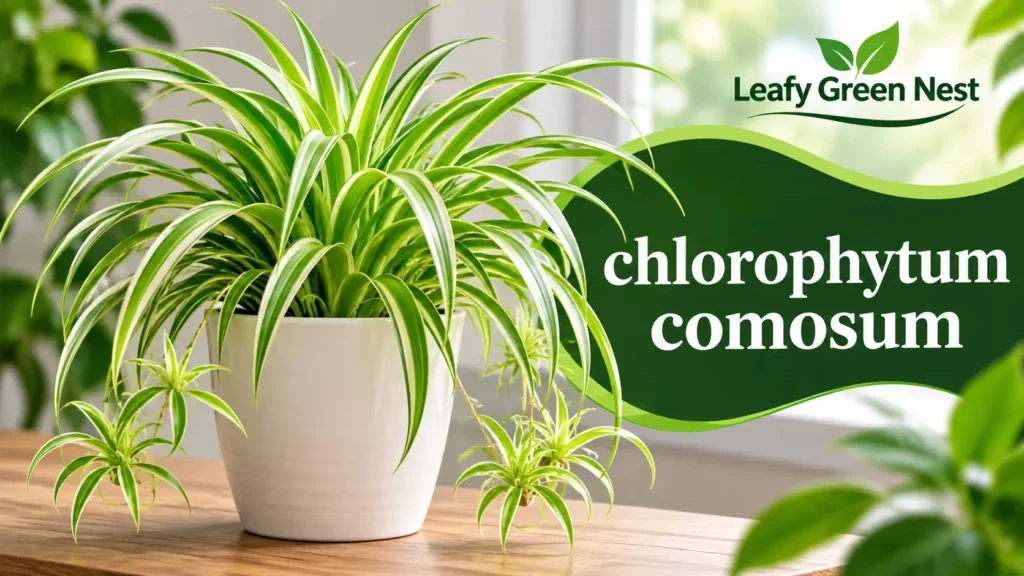
Chlorophytum comosum is a popular evergreen perennial houseplant commonly known as the spider plant. It is famous for its arching striped leaves, easy-care nature, and ability to produce small baby plants.
Native to tropical and southern Africa, this plant belongs to the Asparagaceae family. It grows in attractive clumps and produces long, narrow leaves that spread outward from a central crown.
Spider plants are popular among beginners because they tolerate different indoor conditions and do not require complicated maintenance. Mature plants also produce delicate white flowers and long stems carrying young plantlets.
Depending on the cultivar, the foliage can be entirely green, green with white edges, or striped with creamy centers. Some varieties, such as ‘Bonnie’, have naturally curled leaves.
Table of Contents
Chlorophytum Comosum Common Name and Plant Characteristics
The most recognized Chlorophytum comosum common name is spider plant. Other names include ribbon plant, airplane plant, spider ivy, and walking anthericum.
Its botanical characteristics make it easy to recognize and distinguish from other indoor plants.
| Plant characteristic | Description |
|---|---|
| Botanical name | Chlorophytum comosum |
| Common name | Spider plant |
| Plant family | Asparagaceae |
| Native region | Tropical and southern Africa |
| Plant type | Evergreen perennial |
| Growth habit | Clumping and cascading |
| Leaf shape | Narrow, linear, grass-like |
| Flower color | White |
| Light requirements | Bright, indirect light |
| Soil preference | Well-draining potting mix |
| Propagation | Spiderettes and division |
| Maintenance level | Low |
| Pet safety | Generally non-toxic to cats and dogs |
A mature plant typically develops a compact crown and arching foliage. Its fleshy roots store water and nutrients, helping it tolerate occasional dry conditions.
Chlorophytum Comosum Care: Light, Water and Soil
Chlorophytum comosum care is straightforward when you provide suitable light, balanced watering, and good drainage. The plant adapts to indoor environments, but consistent conditions encourage healthier foliage and stronger growth.
Light Requirements
Spider plants grow best in bright, indirect light. An east-facing window is often ideal because it provides gentle morning sunlight without exposing the foliage to intense afternoon heat.
They can tolerate lower light, but growth may slow down and variegated leaves may lose some of their contrast.
Follow these lighting tips:
- Place the plant near a bright window.
- Provide filtered or indirect sunlight.
- Avoid strong afternoon sunlight.
- Use a grow light if natural lighting is limited.
Watering Requirements
Water Chlorophytum comosum when the upper inch of soil feels dry. The plant prefers slightly moist soil but can develop root problems if its roots remain waterlogged.
Use this simple watering routine:
- Check the top layer of soil with your finger.
- Water thoroughly when it begins to dry.
- Allow excess water to escape through drainage holes.
- Empty the saucer after watering.
- Check soil moisture before watering again.
Watering frequency depends on temperature, pot size, humidity, and light exposure. During hot weather, the soil may dry faster. Reduce watering when growth slows in cooler months.
Brown leaf tips can sometimes result from fluoride, mineral buildup, irregular watering, or excessive fertilizer. If the problem continues, try rainwater or filtered water.
Best Soil and Fertilizer
Spider plants need loose, well-draining soil that allows air to reach their roots. A standard indoor potting mix with added perlite provides a suitable growing environment.
For a simple homemade mixture, combine two parts potting soil, one part perlite, and one part coco coir.
Feed the plant with a balanced liquid houseplant fertilizer during active growth. A diluted application every four to six weeks during spring and summer is usually sufficient.
Avoid overfertilizing because excessive nutrients can damage leaf tips and reduce the production of baby plants.
Temperature and Humidity
Chlorophytum comosum generally grows well at temperatures between 18°C and 27°C. Average household humidity is usually sufficient, so special humidity equipment is rarely necessary.
Protect the plant from freezing temperatures, cold drafts, heaters, and strong air-conditioning vents.
Popular Chlorophytum Comosum Varieties and Their Differences
Chlorophytum comosum varieties differ mainly in their leaf patterns, colors, and growth habits. Four popular cultivars are ‘Ocean’, ‘Variegatum’, ‘Bonnie’, and ‘Vittatum’.
Chlorophytum Comosum ‘Ocean’
Chlorophytum comosum ‘Ocean’ is a compact cultivar with green leaves and attractive cream-colored margins. Its shorter foliage creates a neat appearance that works well in smaller spaces.
Unlike some traditional spider plants, ‘Ocean’ has a more compact growth habit. It is suitable for shelves, office desks, decorative containers, and indoor plant arrangements.
Chlorophytum Comosum ‘Variegatum’
Chlorophytum comosum ‘Variegatum’ features green leaves with white margins along their outer edges. Its contrasting foliage makes it a popular choice for hanging baskets and indoor gardens.
Bright, indirect light helps maintain its attractive leaf pattern. Avoid strong sunlight, which can scorch the foliage.
Chlorophytum Comosum ‘Bonnie’
Chlorophytum comosum ‘Bonnie’ is recognized by its naturally curly leaves and compact growth. Its dark green foliage usually features a creamy stripe running through the center.
This variety is particularly attractive in small decorative pots and hanging containers. Its twisted leaves give it a different appearance from traditional spider plants.
Chlorophytum Comosum ‘Vittatum’
‘Vittatum’ has green leaves with a broad white or cream stripe running down the center. Its long, arching foliage creates an elegant cascading appearance.
It is an excellent choice for hanging planters and indoor spaces where its foliage can spread naturally.
Spider Plant Variety Comparison
| Cultivar | Main leaf feature | Growth habit |
|---|---|---|
| ‘Ocean’ | Green center with cream margins | Compact |
| ‘Variegatum’ | Green leaves with white edges | Arching |
| ‘Bonnie’ | Curly leaves with central stripes | Compact |
| ‘Vittatum’ | Broad central white stripe | Cascading |
All four cultivars generally require similar growing conditions. Their differences are mainly decorative rather than related to basic care.
Chlorophytum Comosum Propagation: Three Easy Methods
Chlorophytum comosum propagation is one of the easiest ways to grow new houseplants. Mature plants produce small baby plants called spiderettes along long stems known as stolons.
These plantlets can develop roots while attached to the mother plant, making propagation simple even for beginners.
Propagation Using Baby Plants
This is the easiest and most reliable method for most home gardeners.
- Select a healthy spiderette growing on the mother plant.
- Check whether small roots have developed near its base.
- Cut the connecting stem using clean scissors.
- Place the baby plant in a small pot with moist potting mix.
- Keep it in bright, indirect light.
- Maintain light moisture while the roots establish.
New leaf growth usually indicates that the young plant is settling into its container.
Propagation in Water
You can also root spider plant babies in water before transferring them into soil.
Place the base of a healthy spiderette in a clean glass of water. Keep the leaves above the waterline and replace the water regularly.
Once healthy roots develop, transfer the plant into a small pot containing well-draining soil.
Propagation Through Division
Older spider plants may develop several growing sections around their central crown. You can separate these sections when repotting.
Remove the plant carefully from its container and loosen the soil around the roots. Separate a healthy section with its own roots and leaves, then plant it in a separate container.
Water lightly and protect the new plant from harsh sunlight while it adjusts.
Chlorophytum Comosum Flower: Appearance and Flowering Conditions
The Chlorophytum comosum flower is small, delicate, and usually white. Flowers develop along long, arching stalks that may also produce baby plantlets.
Each flower typically has six narrow petals. Although the flowers are not as decorative as the foliage, they are an important part of the plant’s natural growth cycle.
A mature plant receiving suitable light and care is more likely to produce flowers and spiderettes.
Why Is My Spider Plant Not Flowering?
A spider plant may not flower because it is immature or growing under unsuitable conditions. Insufficient light, excessive fertilizer, and general plant stress can also affect flowering.
Try these improvements:
- Provide bright, indirect light.
- Avoid excessive fertilizer.
- Maintain a consistent watering routine.
- Give the plant time to mature.
- Avoid unnecessary root disturbance.
Flowering is not essential for a healthy spider plant. A plant can produce attractive foliage without developing flowers.
Chlorophytum Comosum Cats: Is the Spider Plant Safe for Pets?
Chlorophytum comosum is listed as non-toxic to cats and dogs by the ASPCA. This makes it a popular houseplant for people who want indoor greenery while keeping pet safety in mind.
However, non-toxic does not mean pets should eat large amounts of the foliage. Cats may chew the long, moving leaves, and eating too much plant material can still cause digestive discomfort.
Follow these precautions:
- Keep the plant away from pets that frequently chew foliage.
- Remove fallen and damaged leaves.
- Provide suitable pet-safe alternatives for chewing.
- Contact a veterinarian if your pet develops concerning symptoms.
Common Chlorophytum Comosum Problems and Their Solutions
Spider plants are generally resistant to serious problems, but incorrect watering, poor drainage, and pests can affect their appearance. Identifying symptoms early helps protect the roots and foliage.
| Common problem | Possible cause | Recommended solution |
|---|---|---|
| Brown leaf tips | Mineral buildup or dry conditions | Check water quality and watering habits |
| Yellow leaves | Overwatering | Improve drainage |
| Soft, dark roots | Root rot | Remove damaged roots and repot |
| Pale foliage | Insufficient light | Move to brighter indirect light |
| Slow growth | Poor growing conditions | Check light, soil, and root health |
| Drooping leaves | Underwatering or root damage | Check soil moisture |
| No baby plants | Immaturity or unsuitable conditions | Improve growing conditions |
Why Are Chlorophytum Comosum Leaves Turning Brown?
Brown leaf tips are one of the most common spider plant problems. They can develop because of fluoride exposure, mineral buildup, irregular watering, or excessive fertilizer.
Start by checking your water source and reducing unnecessary fertilizer. Trim damaged tips with clean scissors if you want to improve the plant’s appearance.
Do not remove entire healthy leaves just because their tips have turned brown.
Why Are Spider Plant Leaves Turning Yellow?
Yellow leaves often indicate overwatering or poor drainage. When soil remains wet for too long, roots may become damaged and struggle to absorb nutrients.
Check the drainage holes and inspect the roots if several leaves turn yellow. Healthy roots should feel firm, while rotting roots are often dark and mushy.
Remove damaged roots and repot the plant in fresh, well-draining soil when necessary.
Which Pests Affect Spider Plants?
Spider plants can occasionally attract spider mites, mealybugs, and scale insects. These pests feed on plant tissues and can weaken the foliage if left untreated.
Look for these warning signs:
- Spider mites: Fine webbing and tiny pale spots on leaves.
- Mealybugs: White, cotton-like clusters around leaves and stems.
- Scale insects: Small, raised brown or tan bumps on foliage.
Isolate an affected plant, remove visible pests, and clean the leaves. For persistent infestations, use an appropriate insecticidal soap according to its label.
Why Is My Spider Plant Not Producing Baby Plants?
Young plants may need time to mature before producing spiderettes. Low light, excessive fertilizer, and unsuitable growing conditions can also affect plantlet production.
Provide suitable indirect light and avoid overfeeding. Healthy mature plants are more likely to produce baby plants under favorable conditions.
For additional botanical information and practical growing instructions, consult this University of Wisconsin Spider Plant Growing Guide.
Benefits of Growing Chlorophytum Comosum Indoors
Chlorophytum comosum offers several benefits that make it a useful addition to indoor plant collections. Its attractive foliage, easy propagation, and adaptable growth make it suitable for different rooms and experience levels.
The main benefits include:
- Easy maintenance: Suitable for beginners and experienced plant owners.
- Decorative foliage: Adds attractive greenery to indoor spaces.
- Simple propagation: Produces baby plants that can grow independently.
- Hanging baskets: Its arching leaves create a cascading appearance.
- Pet-friendly option: Generally listed as non-toxic to cats and dogs.
- Adaptability: Tolerates a range of indoor lighting conditions.
Spider plants are also commonly promoted as natural air purifiers. Some laboratory studies show that houseplants can remove certain airborne pollutants under controlled conditions. However, ordinary indoor plants should not replace ventilation or air filtration.
Chlorophytum Comosum Indoor Placement and Growing Conditions
Choosing the right location helps maintain healthy foliage and reduces common growing problems. Spider plants are flexible, but they perform best when protected from harsh sunlight and temperature extremes.
| Indoor location | Suitability | Growing advice |
|---|---|---|
| Living room | Excellent | Place near filtered natural light |
| Bedroom | Excellent | Use a shelf or decorative pot |
| Home office | Excellent | Choose a compact cultivar |
| Kitchen | Good | Keep away from cooking heat |
| Shaded balcony | Good | Protect from strong afternoon sun |
| Dark corner | Limited | Supplement with a grow light |
In hot climates, protect spider plants from intense afternoon sunlight and excessive summer heat. A bright indoor position with good air circulation is often more suitable than an exposed outdoor location.
Chlorophytum Comosum Pros and Cons
Spider plants are attractive, adaptable, and relatively easy to maintain. However, understanding their limitations helps you provide the right care and avoid unnecessary problems.
| Pros | Cons |
|---|---|
| Easy to grow | Brown leaf tips can develop |
| Beginner-friendly | Requires occasional pruning |
| Produces baby plants | Can become crowded |
| Attractive foliage | Strong sunlight can cause scorching |
| Generally non-toxic to pets | Pets may chew the leaves |
| Suitable for hanging baskets | Needs occasional repotting |
Overall, the advantages make Chlorophytum comosum a practical choice for indoor gardening.
Chlorophytum Comosum Care Checklist
A consistent maintenance routine helps your spider plant stay healthy throughout the year. Use this checklist to monitor its basic growing requirements and prevent common problems.
- Provide bright, indirect light.
- Use loose, well-draining potting soil.
- Water when the upper soil layer begins to dry.
- Choose a container with drainage holes.
- Maintain comfortable indoor temperatures.
- Feed lightly during active growth.
- Remove dead and damaged leaves.
- Inspect regularly for pests.
- Repot when the roots become crowded.
- Propagate healthy baby plants when needed.
Why Chlorophytum Comosum Is Worth Growing in Your Home
Chlorophytum comosum is an excellent choice for anyone who wants attractive indoor greenery without a complicated maintenance routine. Its arching leaves, distinctive cultivars, and easy propagation make it a valuable addition to home gardens.
Whether you choose ‘Ocean’, ‘Variegatum’, ‘Bonnie’, or ‘Vittatum’, each cultivar offers a different appearance while sharing similar care requirements.
Provide suitable indirect light, avoid overwatering, use well-draining soil, and give the roots enough room to grow. With these simple practices, your spider plant can remain healthy and produce new baby plants for years.
Frequently Asked Questions About Chlorophytum Comosum
What is the common name of Chlorophytum comosum?
Chlorophytum comosum is commonly called the spider plant. Other names include ribbon plant, airplane plant, spider ivy, and walking anthericum.
Is Chlorophytum comosum easy to grow indoors?
Yes. It is an easy-care houseplant that grows well in bright, indirect light. Moderate watering, suitable temperatures, and well-draining soil help maintain healthy growth.
Can Chlorophytum comosum grow permanently in water?
Yes, it can be maintained in water with appropriate nutrient management and regular water changes. However, growing it in potting soil is generally easier for beginners.
Should I remove baby plants from my spider plant?
No. Removing baby plants is optional. You can leave them attached for a cascading appearance or separate them to grow additional spider plants.
Why does Chlorophytum comosum develop brown leaf tips?
Brown tips can result from fluoride exposure, mineral buildup, inconsistent watering, or excessive fertilizer. Check your water quality and adjust your watering routine.
Does Chlorophytum comosum need direct sunlight?
No. It prefers bright, indirect light. Gentle morning sunlight is usually tolerated, but strong afternoon sunlight can scorch the leaves.


