
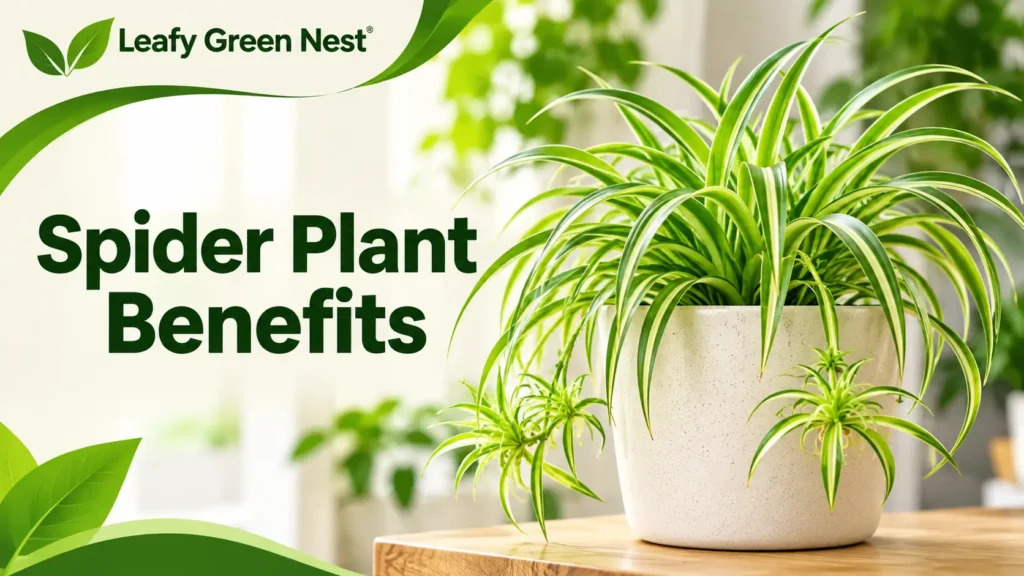
Spider plant benefits go beyond beautiful green leaves. This popular indoor plant adds natural beauty to your home, requires little maintenance, and produces baby plants that you can grow in other pots.
Known scientifically as Chlorophytum comosum, the spider plant is a favorite among indoor gardeners. It is suitable for bedrooms, living rooms, offices, and small apartments. However, questions about its air-purifying abilities, nighttime oxygen production, skincare uses, and possible disadvantages deserve a closer look.
Let’s explore what makes this plant special, what science actually says about its benefits, and how to grow a healthy spider plant at home.
Table of Contents
What Is a Spider Plant?
A spider plant is an evergreen houseplant recognized by its long, narrow leaves and cascading growth. It belongs to the Asparagaceae family and originally comes from southern Africa.
Its leaves usually feature green and white stripes, although completely green varieties are also available. Mature plants produce long stems with small baby plants called spiderettes.
Spider plants are also known as ribbon plants, airplane plants, and spider ivy. They are popular because they adapt well to indoor environments and require relatively little maintenance.
Key Takeaways About Spider Plant Benefits
Spider plants offer several practical advantages, especially for people who want attractive indoor greenery without complicated maintenance. Their strongest benefits relate to decoration, easy propagation, and beginner-friendly care.
- They are relatively easy to grow and maintain.
- They add natural greenery to indoor spaces.
- They produce baby plants for propagation.
- They are listed as non-toxic to cats and dogs by the ASPCA.
- They can absorb certain airborne pollutants in laboratory conditions.
- They do not replace ventilation or air purifiers.
- Their skincare benefits have not been established through reliable clinical research.
- Overwatering can cause root damage and encourage fungal growth.
Major Spider Plant Benefits for Your Home
Spider plants are useful decorative houseplants that combine attractive foliage with simple growing requirements. Here are the main reasons why they deserve a place in your indoor garden.
Adds Natural Beauty to Indoor Spaces
One of the biggest spider plant benefits is its attractive appearance. Its long, arching leaves create a fountain-like shape that looks beautiful in different home interiors.
You can place spider plants on floating shelves, window ledges, office desks, or hanging baskets. Their green and white leaves add color without making a room feel crowded.
They are especially useful for small apartments because they require little floor space.
May Help Absorb Certain Airborne Pollutants
Spider plants are often promoted as natural air purifiers because research has shown that they can absorb certain volatile organic compounds (VOCs) under controlled laboratory conditions.
VOCs are chemicals released by paints, cleaning products, furniture, and other household materials.
However, laboratory experiments do not represent normal household conditions. A 2019 review by Bryan Cummings and Michael Waring, published in the Journal of Exposure Science & Environmental Epidemiology in 2020, found that ordinary potted plants have limited effects on indoor air quality compared with normal ventilation.
Therefore, spider plants are attractive indoor additions, but they cannot replace air filtration or fresh-air circulation.
Spider Plant Benefits in Bedroom Spaces
Spider plant benefits in bedroom spaces mainly relate to decoration, convenience, and creating a more natural atmosphere. Their attractive leaves can make a bedroom feel more welcoming without requiring much maintenance.
Some reasons to keep one in your bedroom include:
- It adds natural greenery.
- It fits on shelves and bedside tables.
- It grows well in indirect sunlight.
- It is relatively easy to maintain.
- It is considered non-toxic to cats and dogs.
Place your plant near a window where it receives bright, indirect sunlight. Avoid placing it beside heaters or air conditioners.
A spider plant cannot cure insomnia or guarantee better sleep, but it can make your bedroom more attractive.
Spider Plant Benefits at Night
Many people believe spider plants release large amounts of oxygen at night. However, this is a common misconception.
Spider plants use oxygen during normal respiration, just like other plants. They mainly produce oxygen through photosynthesis when they receive suitable light.
You can safely keep a healthy spider plant in your bedroom overnight, but you should not expect it to increase bedroom oxygen levels significantly.
Its main nighttime benefit is its natural appearance rather than a special oxygen-producing ability.
Generally Safe for Cats and Dogs
Another useful spider plant benefit is its pet-friendly classification. The American Society for the Prevention of Cruelty to Animals (ASPCA) lists Chlorophytum comosum as non-toxic to cats and dogs.
This makes spider plants a popular choice for households with pets.
However, non-toxic does not mean pets should eat unlimited quantities. Chewing large amounts of leaves can still cause mild digestive discomfort.
If your cat or dog regularly chews indoor plants, consider using a hanging basket.
Easy to Grow and Maintain
Spider plants are excellent choices for beginners because they tolerate different indoor conditions and occasional care mistakes.
They do not require complicated gardening techniques or constant attention.
Basic care includes:
- Bright, indirect sunlight.
- Well-draining potting soil.
- Moderate watering.
- A container with drainage holes.
- Occasional removal of damaged leaves.
Their ability to tolerate some neglect makes them suitable for busy households, students, and people who are new to indoor gardening.
Produces Baby Plants for Easy Propagation
Spider plants naturally produce small baby plants called spiderettes. These grow along long stems extending from the parent plant.
Once the baby plants develop roots, you can separate them and grow new spider plants.
This allows you to decorate different rooms, share plants with friends, and expand your collection without purchasing additional mature plants.
It is also one of the easiest ways for beginners to learn plant propagation.
Affordable and Budget-Friendly
Spider plants are generally affordable compared with many decorative indoor plants. Their ability to produce baby plants makes them even more economical.
The Spider Plant price depends on plant size, variety, nursery, pot design, and delivery charges.
In Pakistan, individual online nursery listings have shown examples around PKR 170 to PKR 350. These are seller-specific examples, not a fixed market price.
Before buying, compare the plant’s health, leaf condition, root development, and pot quality.
Makes Offices and Workspaces More Attractive
Spider plants can make offices and workspaces feel more welcoming by introducing natural greenery.
Their compact growth makes them suitable for desks, shelves, and hanging planters.
You can use them to decorate:
- Home offices.
- Study tables.
- Reception areas.
- Meeting rooms.
- Workplace shelves.
Greenery can also make an indoor environment feel more connected to nature. However, the specific psychological benefits of keeping one spider plant should not be overstated.
Suitable for Small Indoor Spaces
You do not need a large garden to enjoy the beauty of a spider plant. Its flexible growth habit makes it suitable for apartments, small rooms, and compact workspaces.
Hanging baskets are particularly useful because the leaves cascade downward without occupying valuable floor space.
You can also place smaller plants on window ledges, floating shelves, and decorative stands.
Relatively Resistant to Common Growing Problems
Spider plants are fairly resilient and can tolerate occasional watering mistakes. They also adapt to different indoor lighting conditions, although bright, indirect light is generally better.
However, they still need proper care.
Strong direct sunlight can scorch the leaves, while excessive watering can damage the roots. Poor growing conditions may also cause brown leaf tips and slow growth.
Their resilience makes them a good choice for people who are still learning indoor gardening.
Creates a More Relaxing Indoor Environment
Green plants can make indoor spaces feel more natural and comfortable. Spider plants offer a simple way to introduce greenery into your surroundings.
Their soft leaves and cascading shape add visual interest without making a room feel crowded.
Many people also enjoy caring for houseplants as a relaxing hobby. However, spider plants should not be considered treatments for anxiety, depression, or other medical conditions.
Spider Plant Benefits for Skin: Is It Effective?
Spider plant benefits for skin are sometimes discussed in traditional remedies and home-gardening conversations. However, there is insufficient reliable clinical evidence that spider plants improve human skin health.
Some online claims suggest that spider plant leaves can moisturize skin, treat acne, or reduce irritation. These benefits have not been established through reliable human clinical studies.
| Skin-related claim | Scientific evidence |
|---|---|
| Moisturizes dry skin | Not established |
| Treats acne | Not established |
| Removes blemishes | Not established |
| Reduces wrinkles | Not established |
| Heals wounds | Not established |
| Treats skin irritation | Not established |
Avoid applying crushed leaves or homemade extracts directly to your face. For skin problems, use products with established safety information or consult a dermatologist.
Spider Plant Benefits Spiritual: What Do People Believe?
Spider plant benefits spiritual are commonly discussed in traditional beliefs and Feng Shui-inspired home decoration. Some people associate this plant with positive energy, peace, growth, and good fortune.
Common symbolic associations include:
- Good luck and prosperity.
- Peace and harmony.
- Positive energy.
- Personal growth.
- Protection from negative influences.
These associations are cultural and personal beliefs rather than scientifically proven effects.
Some homeowners place spider plants near windows or entrances because they believe greenery welcomes positive energy. Others simply enjoy their attractive appearance.
You can appreciate these symbolic meanings without expecting guaranteed spiritual or financial benefits.
Spider Plant Benefits With Mold: Can It Remove Mold?
Spider plants cannot reliably remove mold from indoor environments. An ordinary potted plant cannot clean mold from walls, ceilings, furniture, or carpets.
In fact, poorly maintained houseplants can contribute to moisture-related problems.
Overwatering, poor drainage, and constantly damp soil can encourage fungal growth around the pot.
If you notice mold on your spider plant’s soil:
- Reduce unnecessary watering.
- Allow the upper soil layer to dry.
- Check that the pot has drainage holes.
- Remove visibly moldy soil when appropriate.
- Improve airflow around the plant.
- Avoid keeping the pot in an excessively damp location.
For household mold, control moisture and address its source rather than relying on indoor plants.
For additional practical information about growing and maintaining spider plants, read the Royal Horticultural Society’s spider plant growing guide.
Spider Plant Disadvantages and Possible Side Effects
Although spider plants have several advantages, they also have a few disadvantages. Understanding these problems will help you maintain a healthy plant and avoid common gardening mistakes.
Brown Leaf Tips
Brown leaf tips are among the most common spider plant problems. They may develop because of mineral buildup, inconsistent watering, low humidity, or excessive sunlight.
Check your watering routine and consider using rainwater if tap water appears to cause recurring problems.
Root Rot From Overwatering
Spider plants dislike constantly wet soil. Excess water can damage their roots and cause yellowing leaves, mushy roots, and unhealthy growth.
Always use well-draining soil and a pot with drainage holes.
Excessive Growth
Mature spider plants can produce many leaves and baby plants. This can make them crowded in smaller spaces.
Trim damaged leaves and remove unwanted baby plants when necessary.
Pest Problems
Spider plants can occasionally attract aphids, scale insects, spider mites, and fungus gnats.
Inspect the leaves regularly and avoid keeping the soil excessively wet.
Pets May Chew the Leaves
Although spider plants are listed as non-toxic to cats and dogs, chewing large quantities of plant material may still cause mild digestive discomfort.
Keep plants out of reach if your pets frequently chew indoor greenery.
Limited Air-Purification Effects
Spider plants can absorb certain airborne pollutants in laboratory conditions, but ordinary household plants cannot replace proper ventilation or air purifiers.
Spider Plant Benefits and Side Effects Compared
| Benefits | Disadvantages |
|---|---|
| Attractive indoor decoration | Requires occasional trimming |
| Easy to grow | Can develop brown tips |
| Produces baby plants | May become crowded |
| Non-toxic to cats and dogs | Excessive chewing may upset pets’ stomachs |
| Suitable for beginners | Overwatering can cause root rot |
| Affordable to propagate | Can attract pests |
For most people looking for an easy-care decorative plant, the advantages outweigh the disadvantages.
Spider Plant Price: How Much Does It Cost?
Spider plant prices vary depending on plant size, variety, nursery, and whether a decorative pot is included. Comparing these details helps you avoid paying extra for a plant that may not be healthy.
In Pakistan, individual online listings have shown prices around PKR 170 to PKR 350. Treat these as examples rather than guaranteed current prices.
Before purchasing, check:
- Leaf condition: Choose plants with healthy green leaves and minimal damage.
- Root health: Avoid plants with mushy or unpleasant-smelling roots.
- Soil condition: The soil should not remain excessively wet.
- Plant size: Compare the number of leaves and overall growth.
- Pot quality: Check whether the pot has drainage holes.
- Delivery charges: Include transportation costs when comparing sellers.
A healthy, established plant is generally a better purchase than a larger plant with damaged leaves or unhealthy roots.
How to Grow and Care for a Spider Plant
Spider plants are easy to maintain, but proper lighting, watering, and soil conditions help them produce healthier leaves and baby plants. Following a simple care routine can prevent many common growing problems.
Choose the Right Location
Spider plants prefer bright, indirect sunlight. Place yours near an east-facing window or in a bright room with filtered natural light.
Avoid strong afternoon sunlight because it can scorch the leaves.
Water Properly
Check the upper inch or two of soil before watering. If it feels dry, water thoroughly until excess water drains from the bottom.
Empty the saucer underneath the pot and reduce watering during cooler months when growth slows.
Use Well-Draining Soil
Choose a good-quality indoor potting mix that retains some moisture but allows excess water to escape.
Avoid heavy garden soil that becomes compacted inside containers.
Choose a Suitable Pot
Plastic, terracotta, and ceramic pots can all work. The most important feature is proper drainage.
Choose a container that provides enough space for the roots without being unnecessarily large.
Remove Damaged Leaves
Use clean scissors to trim brown or damaged leaves. Remove unwanted baby plants if the parent plant becomes overcrowded.
Fertilize Occasionally
Use a balanced liquid houseplant fertilizer during active growth if necessary. Follow the product instructions and avoid excessive feeding.
Repot When Necessary
If roots grow through the drainage holes or the plant becomes crowded, move it into a slightly larger container with fresh potting mix.
How to Propagate a Spider Plant From Baby Plants
Propagation is one of the easiest ways to grow additional spider plants. You can use the baby plants produced by a mature parent plant instead of buying new plants.
Follow these simple steps:
- Find a healthy baby plant: Choose a spiderette with healthy green leaves.
- Check the roots: Select a plantlet with small developing roots when possible.
- Separate it: Use clean scissors to cut the connecting stem.
- Plant it: Place the rooted baby plant in a small pot containing moist potting mix.
- Provide indirect light: Keep it in a bright location away from harsh sunlight.
- Maintain moisture: Water moderately while the roots establish.
You can also root baby plants in water before transferring them into soil.
Spider Plant Benefits: Is It Worth Growing One at Home Today?
Spider plants are worth growing if you want an attractive, affordable, and easy-to-maintain indoor plant. Their biggest advantages include beautiful foliage, simple propagation, beginner-friendly care, and a non-toxic classification for cats and dogs.
They are suitable for bedrooms, living rooms, offices, and other indoor spaces with appropriate lighting.
However, keep your expectations realistic. Spider plants are not medical treatments, skincare products, mold removers, or replacements for air purifiers.
Give your plant suitable light, well-draining soil, and moderate water. With basic care, it can remain an attractive part of your home for years.
Frequently Asked Questions About Spider Plant Benefits
What are the main benefits of a spider plant?
Spider plants add natural beauty to indoor spaces, require little maintenance, produce baby plants, and are considered non-toxic to cats and dogs.
Is a spider plant good for the bedroom?
Yes. Spider plants make attractive bedroom decorations, grow well in bright indirect light, and require relatively little maintenance.
Can spider plants improve indoor air quality?
Spider plants can absorb certain airborne pollutants in laboratory conditions. However, ordinary houseplants cannot replace proper ventilation or air purifiers.
Are spider plant benefits for skin scientifically proven?
No. There is insufficient clinical evidence that spider plants treat acne, moisturize skin, reduce wrinkles, or heal wounds.
Does a spider plant release oxygen at night?
Spider plants do not have a special nighttime oxygen-producing process. They use oxygen during normal respiration at night.
What are the disadvantages of keeping a spider plant?
Common disadvantages include brown leaf tips, root rot from overwatering, occasional pest problems, and excessive growth that requires trimming.


