
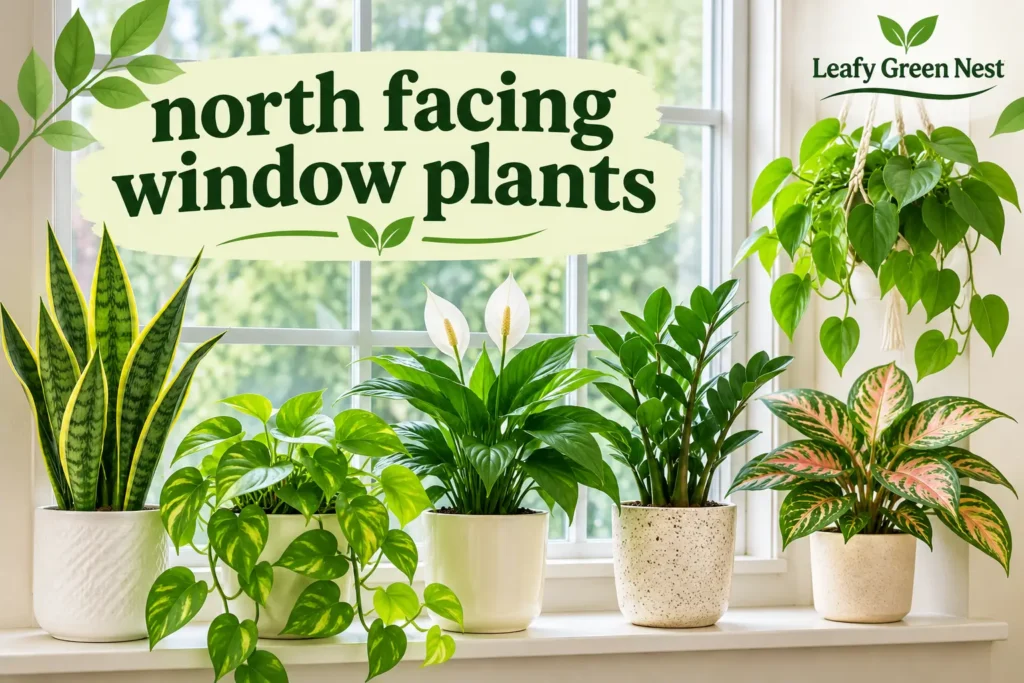
North facing window plants are an excellent choice for homes that receive limited direct sunlight. These indoor plants tolerate lower light conditions and can bring natural greenery to bedrooms, living rooms, kitchens, and small apartments.
You do not need a sunny room to create a beautiful indoor garden. The secret is choosing plants that adapt to indirect light, understanding their watering needs, and placing them where they receive enough natural daylight.
From compact windowsill plants to beautiful trailing varieties, there are plenty of options for a north-facing window. Here are the best choices, along with practical care tips to help them grow.
Table of Contents
What Are North Facing Window Plants?
North facing window plants are indoor plants that grow well in low to moderate indirect light. They are suitable for rooms that receive little direct sunshine but still have natural daylight.
In the Northern Hemisphere, north-facing windows generally receive less direct sunlight than south-facing windows. This makes them particularly suitable for shade-tolerant foliage plants.
Many tropical plants naturally grow beneath larger trees, where they receive filtered sunlight rather than strong direct sunshine. Some of these plants adapt well to north-facing windows.
Quick facts about north-facing window plants:
| Important factor | Details |
|---|---|
| Light requirements | Low to medium indirect light |
| Suitable plant types | Tropical foliage plants |
| Watering | Based on soil moisture |
| Best placement | Near the window |
| Suitable rooms | Bedrooms, kitchens, offices, and living rooms |
| Popular varieties | Pothos, snake plant, and ZZ plant |
| Main challenge | Insufficient natural light |
Remember that low-light plants still need light to survive. A completely dark room cannot support healthy plant growth without suitable artificial lighting.
Best North Facing Window Plants for Indoor Spaces
The best north-facing window plants are varieties that tolerate shade and indirect sunlight. Many are also relatively easy to maintain, making them excellent choices for beginner gardeners.
Here are some attractive plants that can help you create a greener indoor space.
Snake Plant (Dracaena trifasciata)
The snake plant is one of the easiest indoor plants to grow near a north-facing window. Its upright, sword-shaped leaves add height and structure without taking up much space.
It tolerates lower light levels and does not require frequent watering. However, growth may become slower when light is limited.
Care requirements:
- Light: Low to bright indirect light.
- Water: Allow the soil to dry completely between watering.
- Soil: Well-draining cactus or houseplant mix.
- Placement: Windowsills, bedrooms, and office corners.
Choose a compact snake plant variety if you have limited windowsill space.
ZZ Plant (Zamioculcas zamiifolia)
The ZZ plant is popular for its glossy green leaves and ability to tolerate low-light conditions. It is also suitable for people who sometimes forget to water their plants.
Its thick underground rhizomes store water, helping it survive periods of dry soil.
Care requirements:
- Light: Low to medium indirect light.
- Water: Water when the soil has dried out.
- Soil: Well-draining potting mix.
- Placement: Living rooms, offices, and shaded windowsills.
Avoid keeping its roots in standing water because excessive moisture can cause root rot.
Pothos (Epipremnum aureum)
Pothos is one of the best north facing window plants indoors because it adapts to different lighting conditions. Its heart-shaped leaves and trailing stems look beautiful in hanging baskets and on shelves.
Popular varieties include Golden Pothos, Jade Pothos, Marble Queen, and Neon Pothos. Green varieties generally tolerate lower light better than heavily variegated types.
Care requirements:
- Light: Low to bright indirect light.
- Water: Water when the upper soil begins to dry.
- Soil: Loose, well-draining potting mix.
- Placement: Hanging baskets, shelves, and plant stands.
If the stems become stretched with widely spaced leaves, move the plant closer to the window.
Peace Lily (Spathiphyllum)
Peace lilies are attractive foliage plants with broad green leaves and elegant white flower-like structures called spathes. They can tolerate lower light than many flowering houseplants.
However, brighter indirect light generally encourages better flowering. A very dark room may support foliage but produce few flowers.
Care requirements:
- Light: Low to medium indirect light.
- Water: Water when the upper soil begins to dry.
- Soil: Moisture-retaining but well-draining.
- Placement: Living rooms, bedrooms, and shaded corners.
Keep peace lilies away from pets because chewing the leaves can cause mouth irritation.
Chinese Evergreen (Aglaonema)
Chinese evergreen is an excellent choice if you want decorative foliage without needing direct sunlight. Its leaves come in different shades of green, silver, cream, and pink.
Dark green varieties are generally better suited to lower-light rooms than brightly colored cultivars.
Care requirements:
- Light: Low to medium indirect light.
- Water: Allow the upper soil to dry slightly.
- Soil: Well-draining indoor potting mix.
- Placement: Desks, side tables, and windowsills.
This plant is especially useful for adding color to shaded indoor spaces.
Heartleaf Philodendron (Philodendron hederaceum)
Heartleaf philodendron has soft, heart-shaped leaves and attractive trailing stems. It grows well in indirect light and looks beautiful in hanging baskets.
You can also train its stems to climb a moss pole or allow them to cascade from a shelf.
Care requirements:
- Light: Low to medium indirect light.
- Water: Water when the upper soil begins to dry.
- Soil: Airy, well-draining potting mix.
- Placement: Hanging baskets and elevated shelves.
Green-leaved varieties are generally better for lower-light conditions than highly variegated varieties.
Cast Iron Plant (Aspidistra elatior)
The cast iron plant is known for its ability to tolerate challenging indoor conditions. Its long, dark green leaves create a simple and elegant appearance.
It grows slowly and is particularly useful for shaded rooms where other houseplants may struggle.
Care requirements:
- Light: Low to medium indirect light.
- Water: Allow the soil to dry partially between watering.
- Soil: Well-draining potting soil.
- Placement: Floor pots and shaded corners.
It is a good choice if you want a hardy plant that requires relatively little attention.
Spider Plant (Chlorophytum comosum)
Spider plants have narrow, arching leaves with attractive green and white patterns. They produce small baby plants called plantlets, which hang from long stems.
These plantlets can be separated and grown into new plants.
Care requirements:
- Light: Medium indirect light; tolerates lower light.
- Water: Water when the upper soil dries.
- Soil: Well-draining potting mix.
- Placement: Hanging baskets and windowsills.
They are especially suitable for people who enjoy propagating and sharing houseplants.
Parlor Palm (Chamaedorea elegans)
Parlor palm is a compact tropical plant with delicate green fronds. Its soft appearance makes it suitable for bedrooms, living rooms, and small indoor spaces.
It can tolerate lower light levels, although moderate indirect light generally supports healthier growth.
Care requirements:
- Light: Low to medium indirect light.
- Water: Water when the upper soil begins to dry.
- Soil: Moisture-retaining, well-draining mix.
- Placement: Floor planters, side tables, and corners.
Keep it away from strong direct sunlight and cold drafts.
Boston Fern (Nephrolepis exaltata)
Boston fern is a beautiful choice for anyone who prefers lush, full-looking foliage. Its soft, feathery fronds create a natural decorative effect.
It prefers consistent moisture and higher humidity than many other indoor plants.
Care requirements:
- Light: Medium indirect light.
- Water: Keep the soil lightly moist.
- Soil: Rich, moisture-retaining potting mix.
- Placement: Humid bathrooms and bright shaded areas.
A very dark north-facing room may not provide enough light for healthy growth.
Arrowhead Plant (Syngonium podophyllum)
Arrowhead plants have attractive arrow-shaped leaves and a compact growing habit when young. As they mature, their stems can climb or trail.
Green varieties generally tolerate lower light better than highly variegated types.
Care requirements:
- Light: Medium to low indirect light.
- Water: Water when the upper soil begins to dry.
- Soil: Loose, well-draining potting mix.
- Placement: Small shelves and plant stands.
Prayer Plant (Maranta leuconeura)
Prayer plants are popular for their beautifully patterned leaves, which often feature dark green, light green, and red markings.
Their leaves fold upward at night, giving them their common name. They prefer consistent moisture and moderate indirect light.
Care requirements:
- Light: Medium indirect light.
- Water: Keep soil evenly moist but not soggy.
- Soil: Moisture-retaining, well-draining mix.
- Placement: Shelves and shaded windowsills.
They appreciate humidity and should be kept away from dry heating vents.
Bird’s Nest Fern (Asplenium nidus)
Bird’s nest fern has broad, wavy leaves that grow in a circular arrangement. Its bold tropical appearance makes it an attractive addition to indoor spaces.
It prefers indirect light, consistent moisture, and a humid environment.
Care requirements:
- Light: Medium indirect light.
- Water: Keep soil lightly moist.
- Soil: Airy, organic-rich potting mix.
- Placement: Humid bathrooms and sheltered windowsills.
Avoid allowing water to collect in the center of the plant.
English Ivy (Hedera helix)
English ivy is a classic trailing plant with attractive lobed leaves. It works well in hanging baskets and on shelves where its stems can cascade downward.
It prefers cooler conditions and good air circulation.
Care requirements:
- Light: Medium indirect light.
- Water: Water when the upper soil begins to dry.
- Soil: Well-draining potting mix.
- Placement: Cool rooms and shaded windowsills.
Watch for spider mites, especially when indoor air is dry.
Dracaena (Dracaena species)
Dracaena plants are popular indoor choices because of their upright growth and attractive foliage. Some varieties have narrow, arching leaves, while others have broader green leaves with yellow or cream markings.
Greener varieties are generally more suitable for lower-light conditions.
Care requirements:
- Light: Low to medium indirect light, depending on variety.
- Water: Allow the upper soil to dry before watering.
- Soil: Well-draining indoor potting mix.
- Placement: Living room corners and near windows.
North Facing Window Plants Low Light: How Much Light Do They Need?
North-facing windows generally receive less direct sunlight than south-facing windows in the Northern Hemisphere. However, they can still provide useful natural light throughout the day.
The actual light level depends on window size, nearby buildings, trees, curtains, and the distance between the plant and glass.
Plants need light for photosynthesis, the process they use to turn light energy into food. Low-light plants can survive with less light, but their growth may become slower.
For additional horticultural guidance, read the University of Maryland Extension’s related guide: Lighting for Indoor Plants.
Signs Your Window Provides Enough Light
Look for these signs when choosing a location:
- The room receives natural daylight during the day.
- You can comfortably read near the window without turning on a lamp.
- Plants maintain their natural leaf color.
- New leaves develop without excessive stretching.
- Growth remains healthy, even if it is relatively slow.
If plants become weak or stretched, move them closer to the window or consider a grow light.
Small Plants for North Facing Window Spaces
Small plants are ideal for narrow windowsills, desks, shelves, and apartments with limited space. Compact varieties can add greenery without making a room feel crowded.
| Small plant | Best feature | Light requirement |
|---|---|---|
| Baby snake plant | Upright growth | Low to medium |
| Small ZZ plant | Glossy foliage | Low to medium |
| Jade pothos | Trailing stems | Low to medium |
| Chinese evergreen | Decorative leaves | Low to medium |
| Heartleaf philodendron | Heart-shaped foliage | Low to medium |
| Parlor palm | Delicate appearance | Low to medium |
| Arrowhead plant | Attractive leaf shapes | Medium indirect |
Choose a small ZZ plant if you prefer tidy growth. Pothos is a better option if you want greenery that spills over the edge of a shelf.
North Facing Window Plants Indoors: Essential Care Tips
Good placement, proper watering, and regular observation help indoor plants stay healthy near north-facing windows. A few simple habits can prevent common growing problems.
Place Plants Close to the Window
Plants generally receive more light when they are closer to a window. Place low-light varieties on the windowsill or within a few feet of the glass whenever possible.
A dark corner several feet away may receive much less light than the windowsill itself.
Avoid Overwatering
Low-light plants often grow more slowly and use less water. Their soil may also take longer to dry.
Before watering, check the soil with your finger. Water according to the plant’s needs instead of following a fixed daily or weekly schedule.
Choose Pots With Drainage Holes
Drainage holes allow excess water to escape and help prevent root rot. Use a nursery pot inside a decorative container if you want an attractive display.
Never allow excess water to sit around the roots.
Rotate Your Plants
North-facing windows usually provide light from one direction. Rotate your pots occasionally so different sides receive light.
This can help plants maintain more balanced growth.
Keep Leaves Clean
Dust can collect on broad leaves and reduce the light reaching their surfaces. Gently wipe smooth leaves with a damp, soft cloth.
Avoid using leaf-shining products unless they are specifically recommended for your plant.
Watch for Seasonal Changes
Winter days are shorter, and cloudy weather can make north-facing rooms darker. Move plants closer to the window or use supplemental grow lighting if necessary.
Feed Plants During Active Growth
Most tropical houseplants benefit from occasional feeding during active growth. Use a balanced houseplant fertilizer according to the product instructions.
Reduce feeding when growth slows during winter.
North Facing Window Plants No Light: What Are Your Options?
No indoor plant can survive permanently without light because all plants need light for photosynthesis. However, some varieties can tolerate very low-light conditions better than others.
If your room receives almost no natural daylight, consider using a full-spectrum LED grow light.
Good choices for spaces with supplemental lighting include:
- ZZ plant
- Snake plant
- Pothos
- Chinese evergreen
- Cast iron plant
- Peace lily
Artificial room lighting may not provide enough energy for healthy plant growth. A suitable grow light is a better solution for particularly dark spaces.
North East Facing Window Plants: Which Varieties Work Best?
North-east-facing windows can provide gentle morning sunshine and indirect light throughout the day. This exposure can support a wider range of indoor plants than a particularly dark north-facing window.
Consider these varieties:
- Spider plant
- Peace lily
- Pothos
- Prayer plant
- Heartleaf philodendron
- Chinese evergreen
If your window receives several hours of gentle morning sunlight, you may also be able to grow plants that prefer medium light.
South-Facing Window Plants: How Are They Different?
South-facing windows generally receive brighter sunlight and more direct sunshine than north-facing windows in the Northern Hemisphere. They are better suited to plants that need stronger light to grow.
Popular choices include:
- Aloe vera
- Jade plant
- Echeveria
- Cacti
- Hibiscus
- Some varieties of succulents
However, strong summer sunlight can scorch leaves. Monitor your plants and adjust their placement when necessary.
Best North Facing Window Plants by Purpose
Choosing a plant becomes easier when you know what you want from your indoor garden. Some varieties are better for hanging displays, while others work well on small shelves or in shaded corners.
| Your goal | Recommended plant |
|---|---|
| Easiest plant to maintain | ZZ plant |
| Best hanging plant | Pothos |
| Best tall plant | Snake plant |
| Best flowering option | Peace lily |
| Best colorful foliage | Chinese evergreen |
| Best small-space plant | Baby snake plant |
| Best tropical appearance | Parlor palm |
| Best trailing foliage | Heartleaf philodendron |
| Best shaded corner plant | Cast iron plant |
| Best beginner collection | Snake plant, pothos, and ZZ plant |
Common Problems With North Facing Window Plants
Even easy-care plants can develop problems when their growing conditions are unsuitable. Understanding the symptoms can help you correct issues before they affect the entire plant.
| Problem | Possible reason | Solution |
|---|---|---|
| Yellow leaves | Overwatering or poor drainage | Check soil moisture |
| Long, stretched stems | Insufficient light | Move closer to the window |
| Slow growth | Low light or seasonal dormancy | Improve lighting |
| Brown leaf tips | Dry air or inconsistent watering | Review humidity and watering |
| Mushy roots | Waterlogged soil | Improve drainage |
| Pale foliage | Light stress or nutrient issues | Review light and feeding |
One common mistake is watering plants too frequently. Low-light conditions often slow plant growth, so always check the soil before adding more water.
Best North Facing Window Plants for a Greener Home
North-facing windows can support a beautiful indoor garden when you select plants that match the available light. Snake plants, pothos, ZZ plants, Chinese evergreens, and peace lilies are excellent starting choices.
For small spaces, choose compact varieties that fit comfortably on shelves and windowsills. If you prefer trailing greenery, pothos and heartleaf philodendrons are attractive options.
Most importantly, remember that low light does not mean no light. Provide suitable daylight, avoid overwatering, and observe how your plants respond to their surroundings.
Frequently Asked Questions About North Facing Window Plants
These common questions cover plant selection, sunlight, watering, and growing conditions. They also address some of the misconceptions about indoor plants and low-light environments.
What are the best north facing window plants?
Snake plants, ZZ plants, pothos, Chinese evergreens, peace lilies, and cast iron plants are excellent choices because they tolerate lower indoor light.
Can indoor plants grow in a north-facing window?
Yes. Many indoor plants grow well near north-facing windows because they can tolerate indirect sunlight and lower light conditions.
Which small plants are suitable for north-facing windows?
Small ZZ plants, baby snake plants, jade pothos, Chinese evergreens, and compact heartleaf philodendrons are suitable for narrow windowsills and small spaces.
Do north-facing window plants need direct sunlight?
No. Most suitable varieties prefer indirect light and can tolerate limited sunshine. However, they still need sufficient daylight for healthy growth.
How often should I water plants near a north-facing window?
Watering depends on the plant variety, soil, and indoor temperature. Check soil moisture before watering because low-light conditions can slow evaporation.
Can I grow plants in a north-facing window without sunlight?
Plants cannot survive permanently without light. If your room receives almost no natural daylight, use a full-spectrum LED grow light to support healthy growth.


