Are your pothos leaves turning yellow, or does the soil stay wet long after watering? The problem might not be your watering routine. Your plant’s potting mix could be holding too much moisture and leaving its roots with too little air.
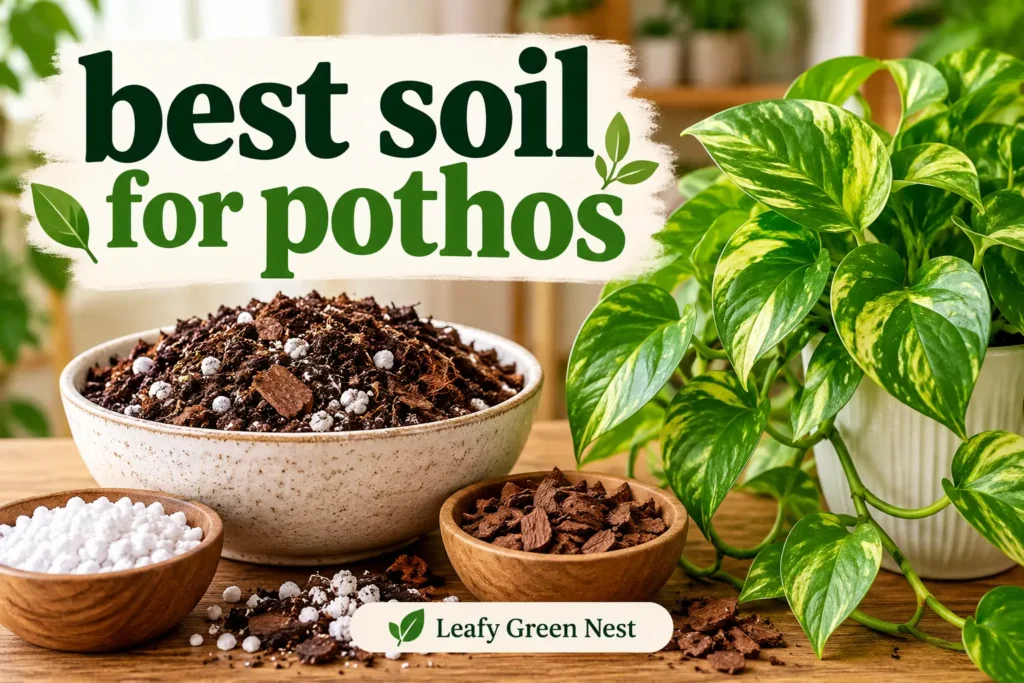
The best soil for pothos provides a balance of moisture retention, drainage, and aeration. This balance helps roots absorb water while allowing excess moisture to escape. Whether you grow golden pothos on a shelf or keep a trailing plant in a hanging basket, choosing the right soil can make everyday care easier. You can buy a suitable houseplant mix or create your own with a few simple ingredients.
Disclosure: This post contains affiliate links. If you purchase through these links, I may earn a commission at no extra cost to you.
Table of Contents
TL;DR: Choosing the Best Pothos Soil
For most indoor pothos plants, start with a quality indoor potting mix. Add perlite and orchid bark if the mix feels dense or remains wet for too long.
- For beginners: Choose a ready-made houseplant potting mix with good drainage.
- For better aeration: Add perlite to help create air spaces in the growing medium.
- For chunky soil: Mix indoor potting soil with perlite and orchid bark.
- For golden pothos: Use a loose mix that retains some moisture without becoming soggy.
- For heavy watering habits: Increase the amount of coarse, moisture-resistant structural ingredients as needed.
- For existing plants: Check the soil’s moisture and texture before repotting unnecessarily.
Penn State Extension recommends a good-quality, well-draining soilless potting mix for pothos. It also advises watering according to soil dryness because excess water can lead to root rot.


Pothos Soil Comparison Table
Different potting mixes can work well for pothos. The best choice depends on how quickly your plant’s pot dries, the ingredients already in your soil, and your watering habits.
| Soil option | Best for | Main benefit | Limitation |
|---|---|---|---|
| Indoor houseplant mix | Most beginners | Convenient, balanced starting point | Some mixes retain too much moisture |
| Houseplant mix with perlite | Typical indoor growing | Improves air space and drainage | May dry faster in warm rooms |
| Potting mix with perlite and orchid bark | Chunky, airy soil | Adds structure and aeration | Requires extra preparation |
| Homemade coir-based mix | DIY growers | Adjustable moisture retention | Needs suitable amendments |
| Succulent soil blend | Growers who already own it | Often drains readily | May dry too quickly on its own |
| Pothos-specific potting mix | Convenient repotting | Designed for houseplants such as pothos | Ingredients and texture vary by brand |
These are practical growing-medium options, not laboratory-tested product rankings. Always check the actual ingredients and how the mix behaves after watering.
Expert Assessment: What Makes Good Pothos Soil?
Pothos, commonly identified as Epipremnum aureum, is a tropical climbing plant that adapts well to indoor conditions. Its roots need access to both water and oxygen, so dense, persistently wet soil is not a good choice.
A suitable mix should perform three jobs.
1. Drain Excess Water
Water should move through the potting mix rather than collect around the roots for long periods. A pot with drainage holes is essential for most soil-grown pothos plants.
Good drainage does not mean the soil must become bone-dry immediately after every watering. Pothos still needs access to moisture between waterings.
2. Maintain Air Pockets
Roots need oxygen for healthy function. A loose, porous mix maintains air spaces even after watering.
Ingredients such as perlite and orchid bark can help create these spaces. The amount you need depends on the texture of your starting mix and your indoor growing conditions.
3. Retain Some Moisture
A mix that drains too quickly may leave the roots dry before your next watering. Organic ingredients such as peat moss or coconut coir help retain moisture.
The goal is not the fastest-draining soil possible. It is a mix that holds enough water for the roots while allowing excess water and air to move freely.
How We Assessed the Options
This guide compares soil types by their ingredients, moisture retention, drainage, aeration, ease of use, and suitability for indoor growing. The recommendations are based on horticultural guidance and ingredient functions, not claimed personal testing. Product-specific performance will vary with the formula, pot, room temperature, light, and watering routine.
Recommended Potting Mixes and Ingredients
You do not need an expensive specialty soil to grow healthy pothos. A suitable houseplant mix can provide a good base, while amendments let you adjust the texture for your home.
Indoor Houseplant Potting Mix
A ready-made indoor potting mix is a practical starting point for new plant owners. Look for a light texture and ingredients that help retain moisture without leaving the roots waterlogged.
Two options to consider are Miracle-Gro Houseplant Potting Mix and Miracle-Gro Organic Indoor Potting Mix. Check each product’s current label before purchasing because formulations can vary.
Pros
- Convenient for beginners who want a ready-made growing medium.
- Provides a consistent starting point for indoor pothos.
- May work well without extra ingredients if the texture is suitable.
Cons
- Some formulas retain too much moisture for certain indoor conditions.
- The word “indoor” does not guarantee the right texture for every pothos plant.
- Additional perlite or bark may be needed if the mix feels dense.
Potting Mix With Perlite
Perlite is a lightweight, porous material made by heating volcanic glass. It is commonly added to growing media to improve aeration and drainage.
If your current pothos soil feels compacted, mixing in horticultural perlite can make the medium more open.
Pros
- Helps create air spaces within the growing medium.
- Can improve drainage when the original mix is dense.
- Useful for adjusting homemade pothos soil recipes.
Cons
- Too much perlite can reduce moisture retention.
- The mix may dry faster in warm rooms or small pots.
- Requires some preparation if you are modifying ready-made soil.
Chunky Pothos Soil With Orchid Bark
A mix of potting soil, perlite, and orchid bark is another option. The bark adds larger pieces that help maintain spaces between the finer ingredients.
This approach is useful for growers who prefer an airy growing medium or find that their existing soil becomes dense after repeated watering.
Pros
- Combines moisture retention with a more open structure.
- Orchid bark adds coarse material that helps maintain air spaces.
- Allows you to adjust the texture to your plant’s conditions.
Cons
- Chunky mixes may dry more quickly than finer mixes.
- Requires extra ingredients and preparation.
- The proportions may need adjustment for your room and watering habits.
Perfect Plants Organic Pothos Soil
Perfect Plants Organic Pothos Soil is another named option to investigate if you prefer a mix marketed specifically for pothos.
Before choosing it, review the current product label for its ingredients, texture, drainage properties, and intended use. A specialty label alone does not prove that a mix is better than a general houseplant medium.
Pros
- Convenient for growers who prefer a ready-made pothos mix.
- May reduce the need to measure and combine separate ingredients.
- Provides an option for those who want a product marketed for pothos.
Cons
- Suitability depends on the actual formula and your indoor conditions.
- The specialty label does not guarantee superior performance.
- Ingredients should be checked before deciding whether amendments are needed.
DIY Pothos Soil Mix Ratio
Making your own pothos soil is straightforward. The following recipe provides a useful starting point for most indoor plants grown in containers with drainage holes.
Ingredients for a DIY Pothos Soil Mix
- 2 parts indoor potting mix: Provides the main growing medium and retains moisture.
- 1 part perlite: Helps increase air space and improve drainage.
- 1 part orchid bark: Adds structure and larger air pockets.
Measure each ingredient by volume, using the same cup or container. This gives you a total of four parts.
This 2:1:1 pothos soil mix ratio provides a moisture-retaining base with two amendments that help create a looser texture. It is a practical starting recipe, not a universal requirement.
How to Make the Mix
- Measure two parts of indoor potting mix into a clean bucket.
- Add one part horticultural perlite and mix gently.
- Add one part orchid bark and combine the ingredients evenly.
- Check the texture by lightly squeezing a handful. It should hold some moisture but should not form a dense, muddy clump.
- Fill a pot with drainage holes, position the pothos roots, and add the mix around them.
- Water thoroughly and allow excess water to drain away.
If your room is warm and the pot dries very quickly, you may need a mix that retains more moisture. If the soil remains wet for too long, consider adding more coarse material or changing your watering routine.
Do not add garden soil directly to an indoor pot. It can become compacted and may not provide the drainage and structure needed for container growing.
Choosing Soil for Different Pothos Varieties
Most common pothos varieties have similar basic soil needs. However, the best mix for an individual plant still depends on its pot, light, room temperature, and watering routine.
Golden Pothos Soil Mix
Golden pothos benefits from a loose, well-draining mix that retains some moisture. A standard indoor potting mix amended with perlite is often sufficient.
If you want a chunkier golden pothos soil mix, add orchid bark. This can help maintain air spaces in the growing medium, particularly when the original soil is dense.
Perfect Plants Organic Pothos Soil, 4 qt, Indoor Coco Coir Mix
rePotme Pothos Soil for Indoor Houseplants
rePotme Pothos Soil is a ready-made potting mix for Golden Pothos, Marble Queen, and other pothos varieties. It offers a convenient alternative to DIY soil mixes. Check the ingredients and drainage properties before use, and choose a pot with drainage holes.
rePotme Pothos/Ivy Potting Soil for Indoor Plants - Imperial Houseplant Potting Mix - Mini Bag (2 Quarts)
Best Soil for Pothos and Philodendron
The best soil for pothos and philodendron often has similar ingredients: a suitable indoor potting mix, perlite, and optional bark. Both groups benefit from growing media that balance water retention with aeration.
However, philodendrons include many species with different growing needs. Check the requirements of your particular plant instead of assuming one recipe is ideal for every philodendron.
Craft Aroid Potting Mix- Elite Organic Alocasia, Philodendron, Monstera Soil Mix, Chunky, Well Draining Potting Soil for Indoor Plants, All Tropical Plants &...
Buying Guide: How to Choose the Right Soil
Choosing a suitable pothos soil mix is easier when you focus on how it performs rather than the name printed on the bag.
Check the Ingredients
Look for a mix designed for indoor container plants. Peat moss or coconut coir can help retain moisture, while perlite and bark can improve the growing medium’s structure.
A product does not need every ingredient to work well. What matters is the balance between moisture retention and aeration.
Consider Your Watering Habits
Your watering routine can help determine which mix is most suitable.
- If you tend to water too often, choose a more open mix and check the soil before watering again.
- If you frequently forget to water, a mix with somewhat greater moisture retention may be easier to manage.
- If your plant sits in a cool, dim room, remember that the soil may dry more slowly.
- If your plant receives brighter indirect light in a warm room, the mix may dry sooner.
Do not rely on a soil recipe alone to correct overwatering. Pot size, drainage holes, light, and watering frequency all matter.
Do You Need Specialty Pothos Soil?
Not necessarily. A suitable general-purpose indoor potting mix can work perfectly well. A specialty pothos mix is worth considering if you prefer a ready-made formula and its ingredients meet your plant’s needs.
Avoid buying a specialty product simply because its label promises better growth. Check its texture, ingredients, and intended use first.
Can I Use Succulent Soil for Pothos?
You can use succulent soil for pothos, but the result depends on the formula. Many succulent mixes are designed to drain quickly and retain less moisture than some tropical houseplants need.
If you already have succulent soil, inspect its texture and how quickly it dries. You may be able to blend it with a suitable indoor potting mix to create a better balance.
Avoid assuming every succulent blend is identical. Some contain more organic material than others, so the label and the mix’s actual behavior matter.
Potting Soil vs. Perlite vs. Orchid Bark
These ingredients serve different purposes rather than competing to do the same job.
| Ingredient | Main role | When it helps |
|---|---|---|
| Indoor potting mix | Main growing medium | Provides moisture retention and root support |
| Perlite | Aeration and drainage | When the base mix is dense |
| Orchid bark | Adds coarse structure | When a chunkier mix is useful |
| Coconut coir | Holds moisture | When the mix needs moisture retention |
| Vermiculite | Holds water and nutrients | When additional moisture retention is appropriate |
Perlite and vermiculite are not interchangeable in every recipe. Perlite is commonly used to improve aeration, while vermiculite generally retains more water.
For additional information about choosing growing media, see the University of New Hampshire Extension guide to potting soil.
Watering, Repotting, and Soil Maintenance
Even the best soil for pothos indoors will not solve every root problem. Proper watering, an appropriate pot, and occasional checks of the growing medium are just as important.
When Should You Water Pothos?
Check the soil before watering rather than following a strict calendar. Allow the upper portion of the mix to dry before watering again, adjusting for pot size, season, temperature, and light.
When watering, moisten the mix thoroughly and let excess water escape through the drainage holes. Empty any saucer or decorative outer pot that collects water.
When Should You Repot?
Repot when the plant has outgrown its container, roots are crowded, or the existing mix has broken down and no longer drains well.
Choose a pot only modestly larger than the existing root ball. A container that is too large can hold more moisture than the roots can use.
If the roots are healthy and the soil drains well, you do not need to repot simply because you want to try a different recipe.
How Often Should You Replace Pothos Soil?
There is no single schedule that suits every plant. Replace the mix when it becomes compacted, decomposes significantly, develops persistent drainage problems, or needs to be changed because of root damage.
Use fresh, appropriate potting medium when repotting. Clean the pot if you are reusing it, and check that the drainage holes remain clear.
Troubleshooting Common Pothos Soil Problems
Changes in leaf color or growth can point to soil or watering problems, but they are not always caused by the potting mix alone.
| Problem | Possible cause | What to do |
|---|---|---|
| Yellow leaves | Overwatering, poor drainage, or other plant stress | Check soil moisture and inspect roots if the problem persists |
| Drooping leaves | Soil too dry or too wet | Check moisture before adding water |
| Soil stays wet for days | Dense mix, oversized pot, or low evaporation | Review the mix, pot size, and growing conditions |
| Musty smell | Persistently wet or decomposing medium | Inspect the roots and replace unsuitable soil if needed |
| Slow growth | Low light, seasonal changes, root problems, or nutrition issues | Check growing conditions before adding fertilizer |
| Fungus gnats | Moist organic growing medium can support their larvae | Let the appropriate upper layer dry between waterings and address the underlying moisture problem |
Do not assume every yellow leaf means root rot. Look at the whole plant and check the roots if the soil remains wet or the plant continues to decline. Healthy roots and suitable growing conditions are more useful indicators than any single leaf symptom.
How to Choose the Best Soil for Pothos Indoors
For most indoor growers, a good-quality houseplant potting mix is the simplest starting point. If it retains too much water or feels compacted, adding perlite can improve its structure. Orchid bark is another useful option when you want a chunkier mix.
If you enjoy preparing your own growing medium, try the 2:1:1 combination of indoor potting mix, perlite, and orchid bark. It offers a practical balance of moisture retention and aeration, although the ideal proportions depend on your growing conditions.
You do not need a product marketed specifically for pothos to grow a healthy plant. Focus on drainage, root health, appropriate watering, and a pot that suits the root system. Those basics matter more than choosing an expensive or specialized soil.
Frequently Asked Questions
What is the best soil for pothos indoors?
A loose, well-draining indoor potting mix is a good starting point. Add perlite or orchid bark if the soil remains too wet or becomes compacted.
What is the best pothos soil mix ratio?
Try two parts indoor potting mix, one part perlite, and one part orchid bark by volume. Adjust the proportions according to how quickly your pot dries.
Can I use regular potting soil for pothos?
Yes. A quality indoor potting mix can work well if it drains properly and retains some moisture without becoming waterlogged.
Can I use succulent soil for pothos?
Yes, depending on the formula. If it dries too quickly, blend it with a suitable indoor potting mix to improve moisture retention.
Is perlite necessary for pothos?
No. Perlite is useful when your existing mix is dense or drains poorly, but a potting mix that already has suitable aeration may not need additional perlite.
Can I use the same soil for pothos and philodendron?
Often, yes. Many common pothos and philodendrons grow well in similar, well-draining mixes, although specific philodendron species may have different moisture requirements.