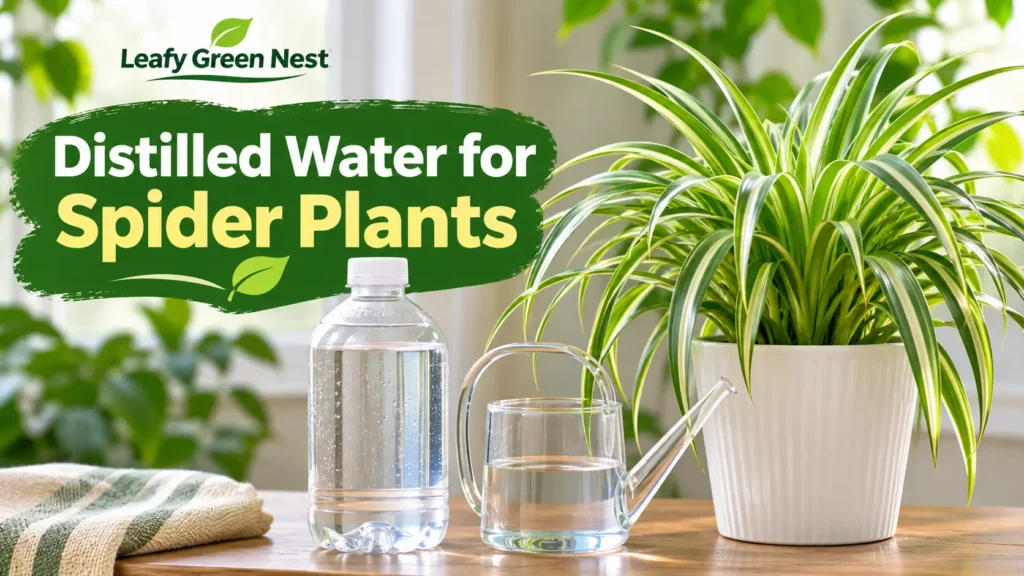
Distilled water for spider plants is purified water made by boiling water and collecting the steam after it condenses. This process removes most dissolved minerals, salts, and other impurities that may affect sensitive houseplants.
Spider plants (Chlorophytum comosum) are popular indoor plants because they are attractive, adaptable, and relatively easy to maintain. However, their leaves can develop brown, crispy tips when exposed to fluoride, excessive salts, or unsuitable growing conditions.
Water quality is one factor that can affect their health. If your tap water contains fluoride or high levels of dissolved minerals, switching to distilled water may help reduce leaf-tip damage and mineral accumulation in the soil.
You do not need distilled water for every spider plant. If your plant grows well with your existing water supply, there may be no reason to change it.
Table of Contents
Key Takeaways About Distilled Water for Spider Plants
Distilled water is a useful option for spider plants because it contains very few dissolved minerals. It can help reduce exposure to substances that contribute to brown leaf tips, especially in areas with hard or fluoridated tap water.
- Distilled water contains very few dissolved minerals.
- It helps reduce fluoride exposure.
- It can limit additional mineral accumulation in potting soil.
- Clean rainwater and reverse osmosis water are suitable alternatives.
- It does not provide meaningful amounts of essential plant nutrients.
- You can use it every time you water your spider plant.
- Overwatering can still cause root rot.
- Brown leaf tips will not turn green again after changing water sources.
- Proper lighting, drainage, and fertilizing remain important.
Quick Reference: Best Water for Spider Plants
| Important factor | Recommendation |
|---|---|
| Best water option | Plain distilled water |
| Natural alternative | Clean rainwater |
| Other suitable option | Reverse osmosis water |
| Water temperature | Room temperature |
| Watering method | Thoroughly water the soil |
| Watering frequency | When the upper soil begins to dry |
| Fertilizing | Balanced houseplant fertilizer |
| Main benefit | Reduced exposure to fluoride and dissolved minerals |
| Main concern | Does not supply meaningful plant nutrients |
| Common problem | Brown, crispy leaf tips |
Why Is Distilled Water Good for Spider Plants?
Distilled water is good for spider plants because it reduces exposure to fluoride and excessive dissolved minerals. These substances can accumulate in the growing medium and contribute to leaf-tip damage over time.
Here are four important reasons to consider using it.
It Reduces Fluoride Exposure
Fluoride is sometimes added to municipal drinking water to help prevent tooth decay. It can also occur naturally in certain water sources.
Spider plants are known to be sensitive to fluoride. Repeated exposure can contribute to brown leaf tips and damaged foliage.
Distillation removes most dissolved fluoride because fluoride does not evaporate with the water under normal distillation conditions. This makes distilled water a useful option when your tap water contains fluoride.
It Helps Reduce Mineral Buildup
Tap water may contain calcium, magnesium, sodium, and other dissolved substances.
Some minerals are useful for plant growth, but excessive accumulation can affect the growing medium. You may notice white deposits on the soil surface, pot edges, or drainage holes.
Using distilled water reduces the amount of additional dissolved minerals entering the pot.
However, it does not remove salts that have already accumulated in the soil. Occasional flushing and sensible fertilizer use may still be necessary.
It May Help Prevent Brown Leaf Tips
Brown leaf tips are among the most common problems experienced by spider plant owners.
Water quality can contribute to this condition, especially when water contains fluoride or excessive dissolved salts.
Other possible causes include:
- Low indoor humidity.
- Underwatering.
- Overfertilizing.
- Poor drainage.
- Root crowding.
- Inconsistent watering.
Switching to distilled water may help when water quality is responsible. If the problem continues, investigate the other growing conditions instead of assuming the water is the only cause.
It Provides More Consistent Water Quality
Tap water quality varies between locations and water treatment systems.
Distilled water has very low mineral content, making it a predictable option for indoor plants. This is particularly useful if you live in an area with hard water or notice mineral deposits around your containers.
Best Distilled Water for Spider Plants: Which Type Should You Choose?
The best distilled water for spider plants is plain, additive-free distilled water without added minerals, fragrances, or unnecessary ingredients. You do not need an expensive specialty product to water your plant properly.
Consider these three options.
Bottled Distilled Water
Bottled distilled water is a convenient choice for people who grow a few indoor plants.
Look for a product labeled 100% distilled water. Avoid flavored varieties or products containing added minerals.
Best for: Small houseplant collections and occasional watering.
Reverse Osmosis Water
Reverse osmosis (RO) water is another suitable option for spider plants.
An RO system uses a special membrane to remove many dissolved minerals and impurities from water. Its effectiveness depends on the system’s quality and maintenance.
Best for: People who regularly water several indoor plants.
Properly Collected Rainwater
Clean rainwater is a natural alternative to distilled water.
It generally contains fewer dissolved minerals than hard tap water. However, collection conditions matter.
Use clean containers and avoid runoff from dirty roofs, contaminated surfaces, or areas exposed to chemicals.
Best for: Gardeners who have access to safe rainwater collection.
How to Make Distilled Water for Plants at Home
You can make distilled water at home using a cooking pot, a heat-safe bowl, and ice cubes. The process works by collecting condensed steam while leaving most dissolved minerals behind.
Follow these instructions carefully.
What You Need
- A large cooking pot.
- A heat-safe glass or stainless-steel bowl.
- Clean water.
- Ice cubes.
- A suitable pot lid.
- A heat source.
Step-by-Step Instructions
Fill the pot with water
Pour ordinary water into a large cooking pot. Leave enough space for the smaller collection bowl.
Place a bowl inside the pot
Position a heat-safe bowl in the center. Make sure it remains stable and does not fill with the original water.
Turn the lid upside down
Place the lid upside down so its lowest point directs condensed water toward the collection bowl.
Add ice cubes
Place ice cubes on the lid. The cold surface helps steam condense into liquid droplets.
Heat the water gently
Bring the water to a gentle boil. Steam rises, touches the cold lid, condenses, and drips into the collection bowl.
Collect the distilled water
Turn off the heat and allow the equipment to cool. Carefully remove the lid and collection bowl.
Your homemade distilled water is ready to use.
Safety tip: Boiling water and steam can cause serious burns. Use heat-resistant equipment, keep the setup stable, and never leave it unattended. Do not seal the pot airtight.
How to Water Spider Plants With Distilled Water
Watering spider plants with distilled water is simple. The most important steps are checking soil moisture, watering thoroughly, and allowing excess water to drain.
Use the following method to maintain healthy roots.
Check the Soil Moisture
Touch the upper inch of the potting mix.
If it feels slightly dry, your plant may need water. If the soil still feels wet, wait before watering again.
Use Room-Temperature Water
Avoid extremely hot or cold water.
Room-temperature distilled water is a practical choice for indoor spider plants.
Water the Soil Evenly
Pour distilled water slowly around the soil surface.
Continue until some water flows through the drainage holes. This helps moisten the root zone more evenly.
Remove Excess Water
Make sure the container has drainage holes.
Empty the saucer after watering so the roots do not remain in standing water.
Monitor New Growth
Observe your spider plant over the following weeks.
Look for healthy new leaves, firm foliage, and fewer newly developing brown tips. Remember that existing brown areas will not recover.
How Often to Water Spider Plants With Distilled Water
You can use distilled water every time you water your spider plant. However, watering frequency depends on soil moisture, temperature, humidity, light, and container size.
Use this seasonal guide as a starting point.
| Season | Watering guidance |
|---|---|
| Spring | Water when the upper soil begins to dry |
| Summer | Check soil more frequently |
| Autumn | Reduce watering as growth slows |
| Winter | Water less frequently |
Spider plants have thick roots that store water. They generally tolerate brief periods of dryness better than constantly wet soil.
Expert tip: Check the soil every few days, but only water when necessary. A fixed daily schedule can lead to overwatering.
Distilled Water for Indoor Plants: Does It Provide Nutrients?
Distilled water contains very few dissolved minerals and does not provide meaningful amounts of the nutrients spider plants need. Your plant must obtain these nutrients from its potting mix or fertilizer.
The essential nutrients include:
- Nitrogen: Supports healthy leaf growth.
- Phosphorus: Supports root development and energy transfer.
- Potassium: Helps maintain overall plant health.
- Calcium: Supports cell structure.
- Magnesium: Helps plants produce chlorophyll.
Should You Add Fertilizer to Distilled Water?
Yes. You can use a suitable water-soluble houseplant fertilizer when your spider plant needs additional nutrients.
Follow these recommendations:
- Choose a balanced houseplant fertilizer.
- Follow the manufacturer’s dilution instructions.
- Fertilize mainly during active growth.
- Avoid excessive feeding.
- Reduce or stop fertilizing during winter if growth slows.
Overfertilizing can cause salt accumulation in the growing medium and contribute to brown leaf tips, even when you use distilled water.
Distilled Water vs. Tap Water for Spider Plants
Distilled water and tap water can both be used for spider plants, but their mineral content is different. The better choice depends on your local water quality and whether your plant shows signs of water-related stress.
| Comparison | Distilled water | Tap water |
|---|---|---|
| Fluoride | Generally removed | May be present |
| Dissolved minerals | Very low | Varies by location |
| Chlorine | Generally removed | May be present |
| Mineral buildup | Minimal contribution | Possible |
| Nutrient content | Very low | Varies |
| Cost | Usually higher | Usually inexpensive |
| Suitability | Excellent | Depends on quality |
Which Water Should You Choose?
Choose distilled water if:
- Your tap water contains fluoride.
- You live in an area with hard water.
- Your spider plant develops recurring brown tips.
- You notice white mineral deposits on the soil.
- Your plant responds poorly to your current water supply.
Tap water may be perfectly acceptable if it has low levels of problematic substances and your plant grows normally.
For more detailed watering advice, see the University of Wisconsin Extension guide to spider plant care. It explains how watering, fertilizer, humidity, and water quality affect spider plant health.
Spring Water vs. Distilled Water for Plants
Spring water and distilled water are both possible watering options, but they contain different amounts of dissolved minerals. Distilled water has very low mineral content, while spring water naturally contains varying amounts of calcium, magnesium, and other substances.
Is Spring Water Better Than Distilled Water?
Not necessarily. Spring water contains naturally occurring minerals that are not automatically harmful to plants, but some brands have higher dissolved mineral concentrations than others.
Distilled water is generally more predictable for fluoride-sensitive spider plants. If you use spring water, check its mineral content rather than assuming every brand is suitable.
Is Filtered Water Good for Spider Plants?
Yes, depending on the filtration method.
Basic carbon filters can reduce chlorine and improve water taste, but they do not necessarily remove fluoride or dissolved minerals.
Reverse osmosis systems remove a wider range of dissolved substances and are generally a better option when mineral reduction is your main concern.
Distilled Water for Spider Plants Reddit: What Do Growers Say?
Discussions about distilled water for spider plants on Reddit often include different experiences. Some plant owners report healthier-looking leaves after switching from tap water, while others find that their spider plants grow perfectly well with ordinary water.
Common observations include:
- Some growers prefer distilled water because they live in hard-water areas.
- Others collect rainwater as a cheaper alternative.
- Some plant owners use reverse osmosis water.
- Several recommend occasional fertilizing when using distilled water.
- Others point out that watering frequency and drainage are just as important as water quality.
These experiences are personal observations, not controlled scientific studies.
The main takeaway is that distilled water can help when water quality contributes to plant problems, but it will not solve every spider plant issue.
Will Distilled Water Kill Plants?
No. Properly produced distilled water does not normally kill plants. It is generally safe for watering spider plants and many other indoor varieties.
However, distilled water contains very few nutrients. Plants still need essential minerals from their potting mix or an appropriate fertilizer.
Using distilled water without providing adequate nutrition over time may contribute to nutrient deficiencies, particularly when the growing medium is already depleted.
Is Distilled Water Good for Bamboo Plants?
Yes. Distilled water can be suitable for lucky bamboo (Dracaena sanderiana).
Lucky bamboo is sensitive to certain substances in tap water, including fluoride. Distilled water or clean rainwater can help reduce exposure.
Remember that lucky bamboo is not a true bamboo species. It is a tropical plant commonly grown in water or soil.
Is Distilled Water Good for Carnivorous Plants?
Yes. Many carnivorous plants, including Venus flytraps and pitcher plants, require water with very low mineral content.
Distilled water, reverse osmosis water, and clean rainwater are common choices because excessive dissolved minerals can damage these sensitive plants.
Always check the specific watering requirements of the carnivorous species you grow.
Where to Buy Distilled Water for Plants
You can find distilled water in supermarkets, grocery stores, pharmacies, household supply shops, and online marketplaces. Plain distilled water is generally sufficient for ordinary houseplant watering.
If you grow several indoor plants, a home reverse osmosis system or safe rainwater collection may be more economical than purchasing bottled distilled water regularly.
Buying tips:
- Look for a label that clearly says distilled water.
- Avoid flavored or scented varieties.
- Avoid products with added minerals.
- Check that the water does not contain unnecessary additives.
- Compare the cost of bottled water with a home filtration system if you have many plants.
Purified drinking water, spring water, mineral water, and distilled water are not necessarily the same. Always check the product label.
Common Mistakes When Using Distilled Water for Spider Plants
Distilled water is a suitable choice, but incorrect watering habits can still damage your plant. Avoid these common mistakes to get better results.
Watering Too Frequently
Distilled water does not prevent root rot. Constantly wet soil can suffocate roots and encourage fungal problems.
Check soil moisture before watering.
Forgetting Fertilizer
Distilled water contains very few nutrients. Your plant still needs nutrition from its growing medium or an appropriate fertilizer.
Expecting Brown Tips to Recover
Damaged leaf tissue cannot turn green again. Focus on preventing new damage instead of trying to restore old leaves.
Buying Expensive Specialty Water
You do not need premium plant-branded water. Ordinary additive-free distilled water is generally sufficient.
Ignoring Other Growing Conditions
Healthy spider plants also need:
- Bright, indirect sunlight.
- Well-draining potting soil.
- Containers with drainage holes.
- Moderate watering.
- Suitable indoor humidity.
- Occasional feeding during active growth.
Expert Tips for Healthier Spider Plants
Good watering habits and suitable growing conditions help spider plants maintain healthy foliage. Use these practical recommendations to improve your plant care routine.
- Use consistent water: Avoid frequently switching between very different water sources.
- Check water quality: Find out whether your tap water contains fluoride or excessive minerals.
- Flush accumulated salts: Occasionally water thoroughly with low-mineral water and allow excess water to drain.
- Avoid excessive fertilizer: Too much fertilizer can cause salt buildup.
- Use room-temperature water: Avoid unnecessary temperature stress.
- Inspect the roots: Spider plants develop thick roots that can fill their containers quickly.
- Watch new growth: Healthy new leaves are a better sign of improvement than old damaged foliage.
Is Distilled Water Worth Using for Spider Plants?
Distilled water is an excellent choice for spider plants, especially when tap water contains fluoride, excessive minerals, or substances that contribute to brown leaf tips. It helps reduce mineral accumulation and provides a predictable water source.
However, it is not essential for every spider plant. If your plant grows well with your existing tap water, there is no need to change your routine unnecessarily.
For the best results, use plain distilled water or clean rainwater, water when the upper soil begins to dry, provide bright indirect light, and fertilize occasionally.
The most important thing is balanced plant care. Distilled water can improve watering conditions, but healthy roots, suitable soil, and consistent maintenance are what keep your spider plant growing beautifully.
Frequently Asked Questions About Distilled Water for Spider Plants
What is the best water for spider plants?
Distilled water, clean rainwater, and reverse osmosis water are excellent choices. They contain fewer dissolved minerals than many hard tap water supplies.
Is distilled water good for spider plants?
Yes. Distilled water helps reduce exposure to fluoride and excessive minerals that may contribute to brown leaf tips and soil buildup.
Can I use distilled water for spider plants every time?
Yes. You can use distilled water every time you water your spider plant. Make sure the soil dries slightly between watering sessions.
How do I make distilled water for plants at home?
Boil water in a pot and collect the condensed steam in a separate heat-safe container. Most dissolved minerals remain in the original pot.
Why do spider plants get brown tips even with distilled water?
Brown tips can result from low humidity, underwatering, overfertilizing, poor drainage, or root crowding. Water quality is only one possible cause.
Does distilled water provide nutrients to spider plants?
No. Distilled water contains very few dissolved minerals. Spider plants still need essential nutrients from potting soil and occasional balanced fertilizer.