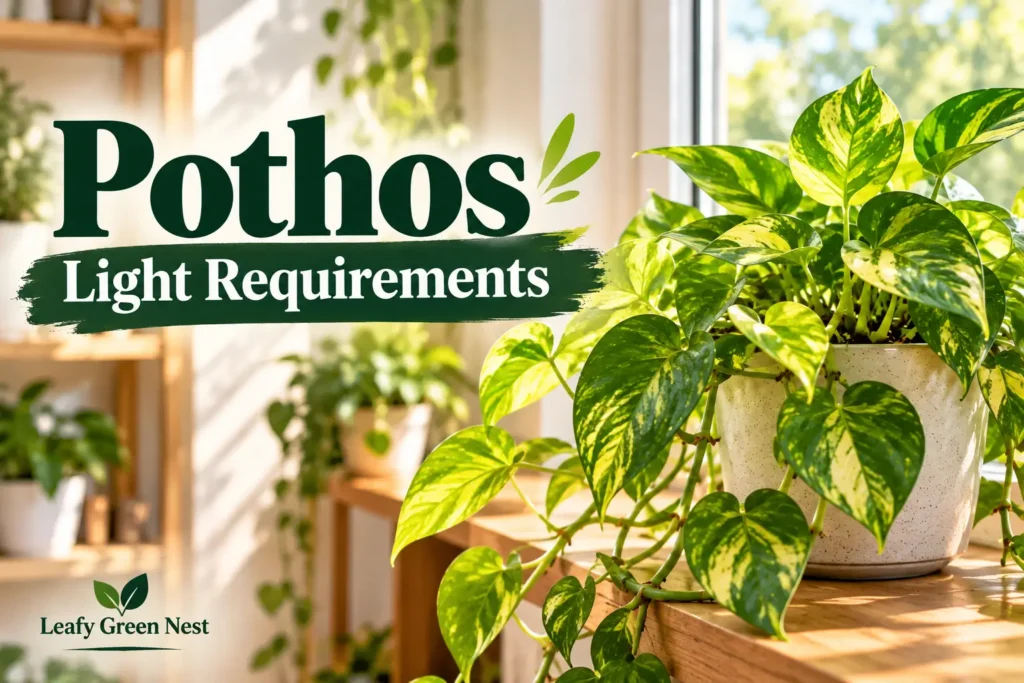
Choosing the right spot for your pothos can make a big difference in how well it grows. While this popular houseplant can tolerate low light, it grows best when it receives the right amount of indirect sunlight. Understanding Pothos Light Requirements helps you keep its leaves healthy, maintain vibrant colors, and encourage fuller, longer vines.
But how much light does a pothos actually need? Does it grow well in a dark room, near a sunny window, or under artificial lights? The answer depends on the variety, your indoor conditions, and the season. In this article, you’ll learn how to choose the best lighting for pothos indoors, recognize signs of too much or too little light, and adjust its care during winter for healthier growth.
Table of Contents
What Are Pothos Light Requirements?
Pothos light requirements describe the amount and intensity of light a pothos plant needs to grow healthy leaves, maintain its color, and produce long, trailing vines. Most pothos plants grow best in bright, indirect light, but they can also tolerate lower-light conditions.
Pothos (Epipremnum aureum) is a popular tropical houseplant known for its heart-shaped leaves, trailing stems, and easy-care nature. It can adapt to many indoor spaces, including bedrooms, offices, living rooms, and kitchens.
However, not every spot in your home provides enough light. A pothos may survive in a dim corner but grow slowly, develop smaller leaves, or lose some of its colorful variegation.
The goal is to provide enough light for steady growth without exposing the leaves to harsh, direct sunlight for long periods.
Quick Answer: How Much Light Does Pothos Need?
Pothos plants prefer bright, indirect light for around 8 to 12 hours daily. They can tolerate lower light, but growth usually slows. Gentle morning sunlight may be beneficial, while strong afternoon sun can scorch the leaves.
| Light factor | Recommended conditions |
|---|---|
| Best light | Bright, indirect light |
| Daily light | Around 8–12 hours of useful light |
| Low light | Tolerated, but growth may slow |
| Direct sunlight | Gentle morning sun is often suitable |
| Artificial lighting | A suitable full-spectrum grow light can work |
| Winter care | Move closer to a bright window if needed |
| Best indoor location | Near an east-facing window or a few feet from a bright window |
These are practical starting points rather than strict rules. Window direction, outdoor weather, glass type, curtains, and the distance from a window all affect how much light reaches your plant.
How Much Light Does Pothos Need Indoors?
Pothos needs enough natural or artificial light to support photosynthesis, the process plants use to turn light into energy. A bright room with filtered daylight is usually a better choice than a dark corner far from a window.
The right location depends on your windows and the pothos variety you grow.
Best Window Direction for Pothos
East-facing windows are the best choice, since they deliver gentle morning sun and bright, indirect light for the rest of the day without scorching the leaves. North-facing windows also work well, offering softer, steadier light, while south- and west-facing windows are fine too if you place the plant a few feet back or filter the harsh afternoon rays with a sheer curtain.
East-facing window: Excellent choice
East-facing windows provide gentle morning sunlight. Place your pothos near the window or slightly farther back if direct rays reach its leaves.
North-facing window: Often suitable
In the Northern Hemisphere, north-facing windows usually provide softer light. Place the plant close to the window, especially if the room is shaded by buildings or trees.
South-facing window: Bright but intense
South-facing windows can provide plenty of light. Use a sheer curtain or move the plant back from the glass to protect it from strong direct sunlight.
West-facing window: Use some protection
Afternoon sunlight can be intense, particularly in summer. Keep the plant out of harsh direct rays while allowing it to receive plenty of indirect light.
Window direction is only a starting point. A shaded east-facing window may provide less light than a bright west-facing window with sheer curtains.
How Far Should Pothos Be From a Window?
Start by placing your pothos about 2 to 5 feet from a bright window, then adjust based on the actual light reaching the leaves.
A plant close to a window receives more light than one placed across the room. However, direct sunlight, seasonal changes, and nearby obstructions can change the ideal distance.
Watch new growth over several weeks. Healthy leaves, compact spacing between leaves, and steady growth suggest that the location is working.
Pothos Light Requirements in Lux and Foot-Candles
Lux and foot-candles measure light intensity. They can help you compare different locations in your home when your eyes cannot tell which spot provides more useful light.
For practical indoor growing, the following ranges can serve as approximate starting points, not fixed scientific thresholds for every pothos cultivar.
| Light level | Approximate illuminance | Expected response |
|---|---|---|
| Very low light | Below 100 lux | Very slow growth and possible leaf loss over time |
| Low light | 100–500 lux | Survival is possible, but growth may be weak |
| Medium light | 500–1,000 lux | Better maintenance growth for adaptable varieties |
| Bright indirect light | 1,000–10,000 lux | Generally favorable for healthy foliage and growth |
| Strong direct sunlight | Often above 10,000 lux | May cause leaf scorch, depending on duration and conditions |
One foot-candle equals approximately 10.76 lux. For example, 1,000 lux is about 93 foot-candles.
Use a light meter or a phone app as a rough comparison tool. Phone readings are not always accurate, and a single measurement does not capture the full day’s light exposure. The duration of light matters, too.
A spot receiving 2,000 lux for several hours is different from one receiving the same reading for a few minutes.
Light Needs of Different Pothos Varieties
Different pothos varieties have different light needs. Green varieties generally tolerate lower light better, while heavily variegated varieties often benefit from brighter indirect light to maintain their patterns.
Golden Pothos Light Requirements
Golden Pothos has green leaves with yellow or golden markings. It adapts to medium and lower light, but brighter indirect light often encourages stronger growth and more visible golden variegation.
Marble Queen Pothos Light Requirements
Marble Queen has cream and white patterns mixed with green. It generally needs brighter indirect light than solid-green varieties to maintain attractive variegation and steady growth.
Avoid harsh sunlight, which can damage its pale leaf sections.
Neon Pothos Light Requirements
Neon Pothos is known for its bright lime-green leaves. It tolerates a range of indoor conditions, but bright indirect light helps support fuller growth and vivid foliage.
If new growth becomes unusually dark or the stems stretch, consider moving it to a brighter location.
Jade Pothos
Jade Pothos has mostly solid-green leaves and is a useful option for spaces with moderate light. It generally handles lower light better than highly variegated types, although it still needs some usable light to grow well.
The key difference is that variegated leaves have less green tissue available for photosynthesis in their pale areas. Brighter indirect light helps the green portions produce enough energy to support the plant.
Pothos Light Requirements in Winter
Pothos light requirements in winter do not change dramatically, but the amount of natural light available often decreases. Shorter days, cloudy weather, and a lower sun angle can reduce the light reaching indoor plants.
Follow these steps to help your pothos through winter:
- Move it closer to a window. A plant that thrives several feet from a window in summer may need to sit closer during winter.
- Clean dusty leaves. Gently wipe the foliage with a damp, soft cloth so dust does not build up on the leaf surfaces.
- Rotate the pot. Turn it occasionally to help different sides receive light and encourage balanced growth.
- Consider a grow light. If natural light is weak, use a suitable full-spectrum LED grow light according to the manufacturer’s distance and timing instructions.
- Reduce watering when necessary. Plants often grow more slowly in winter and use water less quickly.
Avoid placing the plant against cold glass or directly beside a heater. Both locations can create stress unrelated to light.
Can Pothos Grow Under Artificial Light?
Yes. Pothos can grow under artificial light if the light provides enough intensity for a suitable amount of time.
A full-spectrum LED grow light is a practical choice for a dim room, office, or space without a suitable window. Ordinary room lighting may help, but many household bulbs are too weak or too far away to support strong growth.
For better results:
- Position the grow light so it illuminates the foliage evenly.
- Follow the manufacturer’s recommended distance and daily lighting schedule.
- Start with a moderate schedule and observe the plant’s response.
- Avoid overheating the leaves with a lamp placed too close.
- Keep a regular day-and-night cycle rather than leaving the light on continuously.
Signs Your Pothos Is Getting Too Much or Too Little Light
Your pothos often shows visible signs when its lighting conditions are not suitable. However, light is not the only possible cause of leaf problems, so check the soil and roots before making major changes.
| Symptom | Possible light problem | What to do |
|---|---|---|
| Long, bare stems | Insufficient light | Move to brighter indirect light |
| Small new leaves | Low light or other growth stress | Improve light and check root health |
| Fading variegation | Insufficient light | Increase indirect light gradually |
| Brown, crispy patches | Sunburn or dryness | Reduce direct sun and check watering |
| Pale or bleached leaves | Excessive light or sunburn | Move away from harsh direct rays |
| Slow growth | Low light, seasonal slowdown, or root issues | Check light exposure and growing conditions |
| Leaning toward a window | Uneven light | Rotate the pot periodically |
How to Fix a Leggy Pothos
A leggy pothos has long spaces between leaves and sparse growth along its vines. Low light is a common reason.
To improve its appearance:
- Move the plant to a brighter location with indirect light.
- Rotate the pot regularly for more balanced exposure.
- Prune excessively long vines with clean scissors.
- Root healthy cuttings and plant them back into the pot to create a fuller appearance.
- Allow time for new growth to develop under the improved conditions.
Do not expect old stems to become densely covered with leaves overnight. Better lighting supports new growth, while pruning helps reshape the plant.
How Light Affects Pothos Water Requirements
Light and water are closely connected. Pothos growing in brighter conditions often uses water faster because it can photosynthesize and grow more actively. A plant in low light may use water more slowly.
This means you should not follow the same watering schedule for every pothos plant.
Check the soil before watering. If the top 1 to 2 inches feel dry, check deeper into the pot and water when the soil has dried sufficiently. Then allow excess water to drain through the pot’s drainage holes.
A plant in a dim corner may remain wet for longer. Watering it too frequently can lead to root rot, which may cause yellow leaves and weak growth.
Common Pothos Lighting Mistakes to Avoid
Avoid these common mistakes when choosing a location for your pothos.
- Assuming pothos thrives in darkness: It tolerates low light but generally grows better with brighter indirect light.
- Moving it directly into intense sunlight: Increase exposure gradually to reduce the risk of leaf scorch.
- Ignoring seasonal changes: A summer location may become too dim during winter.
- Using fertilizer to fix every problem: Fertilizer cannot replace inadequate light.
- Changing several care conditions at once: Adjust the light first, then monitor the plant before changing watering or feeding routines.
- Judging success by old leaves alone: Check the size, color, and spacing of new leaves to assess whether the new location is working.
Key Takeaways
- Bright, indirect light is best for most pothos varieties.
- Pothos can survive in low light, but it may produce longer gaps between leaves and smaller foliage.
- Variegated varieties, such as Marble Queen, often need brighter conditions to maintain their leaf patterns.
- Neon Pothos benefits from enough light to maintain its bright chartreuse color.
- Strong direct sunlight can cause pale patches, brown edges, and scorched leaves.
- Winter usually means less natural light, so repositioning your plant may help.
- Light affects watering needs because plants in brighter locations often use water faster.
Frequently Asked Questions
What is the best light for pothos plants?
Bright, indirect light is best for most pothos varieties. Place the plant near a bright window where it receives plenty of filtered daylight without prolonged exposure to harsh direct sunlight.
Is pothos suitable for low-light rooms?
Yes. Pothos can survive in low-light rooms, but it usually grows more slowly and may develop smaller leaves and longer spaces between them. A room with some natural light is preferable to a dark, windowless space.
Can pothos grow in direct sunlight?
Pothos can tolerate some gentle direct morning sunlight, especially after gradual acclimation. However, strong midday or afternoon sunlight can scorch its leaves. Filter intense sunlight with a sheer curtain or move the plant farther from the window.
Should I use a grow light for pothos in winter?
Use a grow light if your plant receives too little natural daylight during winter. A full-spectrum LED grow light can help maintain growth, especially in dark rooms or homes with shaded windows.
Why is my Golden Pothos losing its yellow markings?
Low light can cause Golden Pothos to produce greener leaves with less visible yellow variegation. Move it to a brighter spot with indirect light and assess the pattern on new leaves over time.
Does Marble Queen Pothos need more light than Neon Pothos?
Marble Queen generally benefits from brighter indirect light because its pale variegation reduces the green tissue available for photosynthesis. Neon Pothos is also adaptable, but adequate light helps maintain its vivid lime-green foliage.
References:
- Clemson Cooperative Extension: How to Grow Pothos Indoors. Covers light needs, cultivars, watering, and propagation.
- Home & Garden Information Center Penn State Extension: Pothos as a Houseplant. Explains indoor placement and common pothos varieties.
- Extension South Dakota State University Extension: Pothos Houseplant Care. Offers practical guidance on lighting, watering, and foliage problems.