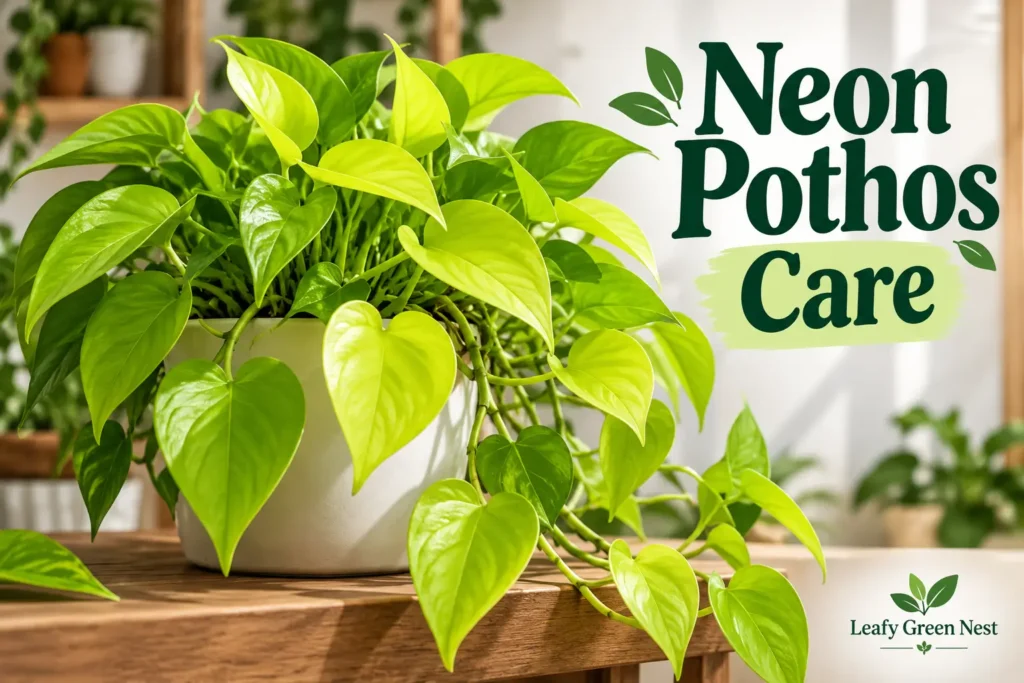
Neon Pothos care is simple once you understand the plant’s needs. With bright green leaves, trailing vines, and a forgiving nature, Neon Pothos is an excellent houseplant for beginners and experienced plant lovers alike. Give it bright, indirect light, water when the top layer of soil dries, and use a well-draining potting mix to keep it healthy.
The best part? You do not need a complicated care routine to enjoy its vivid, lime-green foliage. A few simple habits can help your Neon Pothos grow fuller, produce longer vines, and maintain its beautiful color throughout the year.
Table of Contents
What Is Neon Pothos?
Neon Pothos is a tropical, evergreen climbing vine known for its bright chartreuse or lime-green leaves. Its botanical name is Epipremnum aureum, and it belongs to the Araceae family. It is a popular variety of pothos that grows well indoors and can also thrive outdoors in suitable warm, shaded conditions.
Unlike Golden Pothos, which has green leaves with yellow markings, Neon Pothos usually displays solid, vivid green foliage. Its heart-shaped leaves stand out in hanging baskets, on bookshelves, and along plant supports.
Neon Pothos is native to tropical regions and naturally grows as a climbing vine. Indoors, you can let its stems trail from a pot or train them to climb a moss pole.
Quick Answer: How Do You Care for Neon Pothos?
Neon Pothos care comes down to providing the right balance of light, water, warmth, and drainage. The plant tolerates some neglect, but consistent conditions encourage healthier leaves and stronger growth.
- Light: Bright, indirect light is best.
- Watering: Water when the top 1 to 2 inches of soil feel dry.
- Soil: Use a loose, well-draining potting mix.
- Temperature: Aim for 65–85°F (18–29°C).
- Humidity: Average household humidity usually works, although higher humidity can support growth.
- Fertilizer: Apply a balanced houseplant fertilizer during active growth.
- Pruning: Trim long or bare vines to encourage a fuller appearance.
- Propagation: Root healthy stem cuttings with at least one node.
- Pet safety: Neon Pothos is toxic to cats and dogs if chewed or eaten.
Key Takeaways
- Neon Pothos grows best in bright, indirect light.
- Allow the upper layer of soil to dry before watering again.
- Yellow leaves often indicate overwatering, but other causes are possible.
- Low light can slow growth and reduce the plant’s vibrant appearance.
- Regular pruning helps create a bushier plant.
- Stem cuttings make propagation easy and affordable.
- The plant is tropical, so protect it from frost and cold drafts.
- Keep the plant away from pets and children who might chew its leaves.
Neon Pothos Care Requirements at a Glance
Use this table as a quick reference when setting up your plant’s care routine.
| Care factor | Ideal conditions |
|---|---|
| Light | Bright, indirect sunlight |
| Water | When the top 1–2 inches of soil dry |
| Soil | Airy, well-draining houseplant mix |
| Temperature | 65–85°F (18–29°C) |
| Humidity | Average indoor humidity to moderately high |
| Fertilizer | Balanced liquid fertilizer during active growth |
| Growth rate | Moderate to fast in suitable conditions |
| Pruning | Spring or summer, or as needed |
| Repotting | When roots become crowded |
| Difficulty | Easy for beginners |
These conditions align with recommendations from Penn State Extension, the University of Wisconsin-Madison Division of Extension, and the Royal Horticultural Society.
Neon Pothos Light Requirements
Neon Pothos grows best in bright, indirect light. This means placing it where daylight is strong but the sun’s rays do not directly hit the leaves for long periods.
Light affects both growth and leaf color. Although Neon Pothos can survive in lower-light rooms, it usually grows more slowly in those conditions.
Where should you place Neon Pothos?
Good locations include:
- Near an east-facing window with gentle morning light.
- A few feet from a bright south- or west-facing window.
- In a bright room with filtered daylight.
- Under a suitable grow light if natural light is limited.
If you live in a hot, sunny climate, such as Lahore during summer, keep the plant away from intense afternoon sun. Direct sunlight through glass can scorch the leaves, leaving pale, dry, or brown patches.
Can Neon Pothos grow in low light?
Yes. Neon Pothos can tolerate low light, but it may produce smaller leaves, longer spaces between leaves, and slower-growing vines. Its bright foliage may also look darker or less vibrant.
If your plant looks dull or leggy, move it gradually to a brighter location. Avoid placing it directly under harsh sunlight to compensate for poor lighting.
Expert tip: Rotate the pot every week or two so that different sides receive light. This can help the plant grow more evenly.
Neon Pothos Watering: How Often Should You Water It?
Neon Pothos watering depends on soil moisture, light, temperature, pot size, and the season. Instead of watering on a fixed schedule, check the soil before reaching for your watering can.
For many indoor plants, watering may be needed about once a week, but some need water sooner while others can go considerably longer.
How to water Neon Pothos correctly
Follow these steps:
- Insert your finger about 1–2 inches into the soil.
- If the soil still feels moist, wait a little longer.
- If the upper layer feels dry, water the plant thoroughly.
- Let excess water drain through the pot’s drainage holes.
- Empty the saucer or decorative outer pot so the roots do not sit in standing water.
Water the soil rather than repeatedly splashing the leaves. You do not need to use a small amount every day. Thorough watering followed by a suitable drying period generally works better.
How often should you water Neon Pothos indoors?
Use these estimates as starting points, not strict rules.
| Conditions | Likely watering pattern |
|---|---|
| Warm room with bright light | More frequent checks |
| Cool room with low light | Less frequent watering |
| Small pot or root-filled pot | May dry out faster |
| Large pot with dense soil | May stay wet longer |
| Active growth in spring and summer | Often needs water more frequently |
| Slower growth in winter | Often needs water less frequently |
The best schedule is the one that responds to your plant’s actual soil moisture.
Signs of overwatering
Overwatering is a common reason for unhealthy pothos plants. Watch for:
- Yellowing leaves, especially when several appear together.
- Soil that stays wet for many days.
- Soft, dark, or mushy roots.
- A musty smell coming from the pot.
- Wilting despite wet soil.
If you suspect overwatering, stop watering until you assess the soil and roots. If the roots are brown, mushy, or smell rotten, remove the damaged parts with clean scissors and repot the plant in fresh, well-draining soil.
Signs of underwatering
A thirsty Neon Pothos may show:
- Drooping or limp leaves.
- Dry soil that pulls away from the pot’s edges.
- Curling leaves.
- Dry, crispy leaf tips or edges.
If the soil is very dry, water it thoroughly and let the excess drain. If water runs straight through without wetting the root ball, soak the lower part of the pot briefly and then drain it well.
Common mistake: Yellow leaves do not always mean your plant needs less water. Check soil moisture before deciding what to do.
Best Soil and Pot for Neon Pothos
Neon Pothos needs soil that holds some moisture while allowing excess water and air to move through the root zone.
A dense, compact mix can remain wet for too long and increase the risk of root rot.
What soil is best for Neon Pothos?
A simple potting mix can include:
- Two parts quality indoor potting mix.
- One part perlite or pumice.
- One part orchid bark, if available.
This is a practical starting blend, not a strict formula. You can also use a quality houseplant mix that already drains well.
Perlite and pumice create air spaces. Orchid bark can help keep the mix loose. The goal is to avoid soil that becomes heavy and waterlogged.
Choosing the right pot
Choose a pot with drainage holes. Plastic pots retain moisture longer, while unglazed terracotta allows water to evaporate more quickly.
Select a pot only slightly larger than the current root ball when repotting. An oversized container holds extra soil that can remain wet after watering.
Repot when you notice roots emerging from drainage holes, water moving through the pot unusually quickly because of dense roots, or growth slowing despite good care.
Ideal Temperature and Humidity
Neon Pothos prefers warm conditions and generally adapts well to normal indoor humidity.
A temperature range of 65–85°F (18–29°C) is a useful target. Keep it away from cold drafts, air-conditioning vents, and sudden temperature changes.
Does Neon Pothos need high humidity?
No. High humidity is not essential for a healthy indoor plant. Average household humidity is often sufficient, although moderately higher humidity may support more comfortable growth.
If your home is very dry, consider these options:
- Group several houseplants together.
- Use a room humidifier if needed.
- Keep the plant away from hot air vents.
- Maintain consistent watering and avoid drying the root ball completely for extended periods.
Misting is not necessary for routine care. It does not provide lasting humidity and may leave the foliage wet without solving the underlying problem.
Neon Pothos Fertilizer and Feeding
Neon Pothos benefits from fertilizer during active growth, especially when it has been growing in the same pot for a long time.
Use a balanced liquid houseplant fertilizer according to the label. During spring and summer, feeding about once a month at a reduced concentration can be a reasonable starting point for a plant that is actively growing.
Adjust the frequency to the product instructions, soil type, and plant response.
When should you fertilize Neon Pothos?
- Spring: Begin feeding as new growth appears.
- Summer: Continue moderate feeding while growth remains active.
- Autumn: Reduce feeding as growth slows.
- Winter: Usually pause or reduce feeding when the plant is not actively growing.
Avoid fertilizing dry soil or applying more fertilizer to fix yellow leaves without identifying the cause. Excess fertilizer can build up salts in the soil and damage roots.
If you notice a white crust on the soil or pot rim, or brown leaf tips following repeated feeding, flush the soil thoroughly if drainage is good and review your fertilizer routine.
How to Prune Neon Pothos for Fuller Growth
Pruning helps control the length of Neon Pothos vines and encourages a fuller-looking plant. Without occasional trimming, the stems may become long and sparse, particularly when the plant receives limited light.
Step-by-step pruning instructions
- Choose a healthy vine that has grown longer than you want.
- Find a node, the small point on the stem where a leaf or aerial root emerges.
- Use clean, sharp scissors to cut just above a node on the plant you are keeping.
- Remove yellow, damaged, or dead leaves.
- Adjust the plant’s light conditions if the stems are thin or widely spaced.
New growth may emerge from nodes below a cut, depending on the plant’s condition and growing environment.
How do you make Neon Pothos bushier?
Prune several long vines and plant the rooted cuttings back into the same pot. This adds more stems to the container and can make the plant look fuller.
Remember that pruning alone cannot fix every leggy plant. If light is too low, new growth may remain sparse.
Neon Pothos Propagation: How to Grow New Plants
Neon Pothos propagation is easy because healthy stem cuttings can develop roots in water or a suitable growing medium.
The key is to include at least one node. A leaf without a node will not normally develop into a new vine.
Method 1: Propagate Neon Pothos in water
- Select a healthy stem with at least one or two nodes.
- Cut just below a node using clean scissors.
- Remove any leaf that would sit below the waterline.
- Place the node in a clean glass of water, keeping the leaves above the surface.
- Put the glass in bright, indirect light.
- Change the water when it becomes cloudy and top it up as needed.
- Once the roots are a few inches long and developing well, transfer the cutting to a pot with moist, well-draining soil.
Rooting time varies with temperature, light, and cutting health. Several weeks is common, but there is no guaranteed timeline.
Method 2: Propagate directly in soil
You can also plant the cutting directly into a small pot of lightly moist, well-draining mix.
Make sure at least one node is below the soil surface. Keep the mix lightly moist rather than saturated while roots establish.
Which propagation method is better?
| Method | Advantages | Things to consider |
|---|---|---|
| Water propagation | Roots are easy to see | Cuttings need a transition to soil |
| Soil propagation | Roots develop in their growing medium | Root progress is harder to inspect |
Both methods work. Water propagation is often easier for beginners because you can see when roots begin to form.
Neon Pothos Care Outdoors
Neon Pothos can grow outdoors in warm climates, provided it receives filtered light and protection from harsh conditions.
In suitable tropical or subtropical settings, it can be grown in containers on shaded patios, covered balconies, or sheltered garden areas. In cooler regions, it is better treated as a houseplant or moved indoors when temperatures fall.
Outdoor care tips
- Choose a bright, shaded location rather than harsh afternoon sun.
- Use a container with drainage holes.
- Check soil moisture more often during hot, dry weather.
- Protect the plant from strong wind, heavy exposure, and cold weather.
- Inspect the leaves for pests after bringing the plant indoors.
Outdoor pots can dry much faster than indoor pots. However, heavy rain can also leave soil waterlogged. Adjust watering based on the weather and the condition of the soil.
Do not assume that a plant suitable for outdoor growth in a warm region can survive freezing conditions. Neon Pothos is a tropical plant and does not tolerate frost well.
Why Is My Neon Pothos Turning Yellow?
Yellow leaves are a symptom, not a diagnosis. The most useful clue is whether the soil is wet or dry, how many leaves are affected, and where the yellowing begins.
| Problem | Possible cause | What to do |
|---|---|---|
| Several yellow leaves and wet soil | Overwatering or poor drainage | Check roots and improve drainage |
| Yellowing with very dry soil | Underwatering or inconsistent watering | Water thoroughly and reassess |
| Faded or smaller new leaves | Insufficient light or nutrition | Review light and feeding |
| Brown, crispy patches | Direct sun, dryness, or salt buildup | Check light, moisture, and fertilizer use |
| Yellowing with tiny insects | Pest damage | Inspect both sides of leaves |
| One old leaf turning yellow | Normal aging | Remove it if it becomes fully yellow |
What causes yellow leaves after watering?
If yellowing starts after frequent watering, check whether the soil stays wet for too long. Roots need oxygen as well as moisture.
If the soil is wet and the plant is wilting, do not add more water automatically. Inspect drainage and root health first.
Should you remove yellow leaves?
Yes, you can remove fully yellow or dead leaves using clean scissors. They usually will not turn green again. However, removing leaves will not correct the underlying issue, so address the cause as well.
Common Neon Pothos Pests and Problems
Neon Pothos is generally a resilient houseplant, but it can develop pest problems, especially when growing conditions are poor.
Common pests include mealybugs, scale insects, and spider mites. Look for cotton-like clusters, small brown bumps, fine webbing, or leaves that appear speckled or unusually dull.
How to manage pests
- Inspect the stems, leaf undersides, and leaf joints.
- Isolate the affected plant from other houseplants.
- Wipe off visible pests with a damp cloth.
- If needed, use an insecticidal soap labeled for houseplants, following the product instructions.
- Repeat inspections and treatment as directed.
Avoid applying treatments in intense sunlight or using a homemade mixture that could burn the leaves. Test any suitable product on a small area first if its label recommends doing so.
Why are my Neon Pothos leaves curling?
Curling may occur when the soil is too dry, the plant receives excessive direct sun, or the roots are stressed. Check the moisture level and move the plant away from harsh sunlight if needed.
Why is my Neon Pothos not growing?
Slow growth may be normal in winter, but persistent lack of growth can result from low light, cold temperatures, compacted soil, or root problems. Review these conditions before increasing fertilizer.
Neon Pothos Benefits: Why Grow This Houseplant?
Neon Pothos offers several practical and decorative benefits. Its bright foliage can add color to a room without requiring the care routine of many more demanding tropical plants.
Main benefits of Neon Pothos
- Easy maintenance: It tolerates a range of indoor conditions and does not need daily attention.
- Versatile display: You can grow it in hanging baskets, on shelves, or along climbing supports.
- Simple propagation: Healthy cuttings can produce new plants without buying additional ones.
- Decorative foliage: Its vivid green leaves create a strong contrast against darker furniture and neutral walls.
- Flexible growth habit: You can train it upward or allow the vines to trail.
Is Neon Pothos a money plant?
Neon Pothos is sometimes called a money plant, especially in regions where the name is used for several different houseplants. However, the term “money plant” does not identify one specific species.
Neon Pothos is Epipremnum aureum. In other places, money plant may refer to Pachira aquatica or Crassula ovata, among other plants.
Some people associate money plants with prosperity and good fortune. These are cultural beliefs, not scientifically proven benefits of growing the plant.
Does Neon Pothos purify indoor air?
Plants can absorb certain compounds under controlled conditions, but research does not establish that a typical potted Neon Pothos meaningfully cleans the air in an ordinary home.
Enjoy the plant for its appearance and the pleasure of caring for greenery. For indoor air quality, ventilation and controlling pollution sources are more dependable measures.
Is Neon Pothos Toxic to Pets?
Yes. Neon Pothos belongs to Epipremnum aureum, a species listed as toxic to cats and dogs by the ASPCA. It contains insoluble calcium oxalate crystals that can cause pain and irritation when chewed or swallowed.
Possible symptoms include:
- Drooling or pawing at the mouth.
- Irritation or swelling of the lips and tongue.
- Vomiting.
- Difficulty swallowing.
Keep the plant beyond the reach of pets and young children. Hanging the pot may reduce access, but make sure trailing vines cannot be pulled down.
If a pet chews or swallows the plant, contact a veterinarian for advice. Seek urgent veterinary help if the animal has trouble breathing or swallowing.
Wear gloves when pruning if you have sensitive skin, and wash your hands after handling damaged stems. Plant sap may irritate skin and eyes.
Neon Pothos Care Checklist
Use this simple checklist to keep your plant healthy throughout the year.
Weekly plant care
0/10 completeCheck soil moisture before wateringProvide bright, indirect lightUse a pot with drainage holesRemove dead or yellow leavesInspect leaf undersides for pestsRotate the pot for balanced growthFeed moderately during active growthPrune long or bare vines when neededKeep the plant away from petsCheck roots when repotting
Reset checklist
You do not need to perform every task each week. Watering, pruning, fertilizing, and repotting should follow the plant’s actual needs. The checklist is a reminder to inspect your plant rather than a rigid schedule.
Frequently Asked Questions
What is the best light for Neon Pothos?
Bright, indirect light is best for Neon Pothos. Place it near a bright window and protect its leaves from harsh afternoon sunlight.
How often should you water Neon Pothos?
Water when the top 1–2 inches of soil feel dry. Water thoroughly and let excess water drain to help prevent root rot.
Can Neon Pothos grow in low light?
Yes, Neon Pothos tolerates low light, but growth may slow and its leaves may become less vibrant. Brighter indirect light encourages healthier growth.
Why are my Neon Pothos leaves turning yellow?
Yellow leaves may result from overwatering, poor drainage, low light, or natural aging. Check soil moisture and root health before changing your care routine.
How do you propagate Neon Pothos?
Cut a healthy stem just below a node and place the cutting in water or moist potting mix. Keep it in bright, indirect light while roots develop.
Is Neon Pothos safe for cats and dogs?
No. Neon Pothos contains insoluble calcium oxalate crystals that can irritate the mouth and digestive tract if chewed or swallowed. Keep it away from pets.