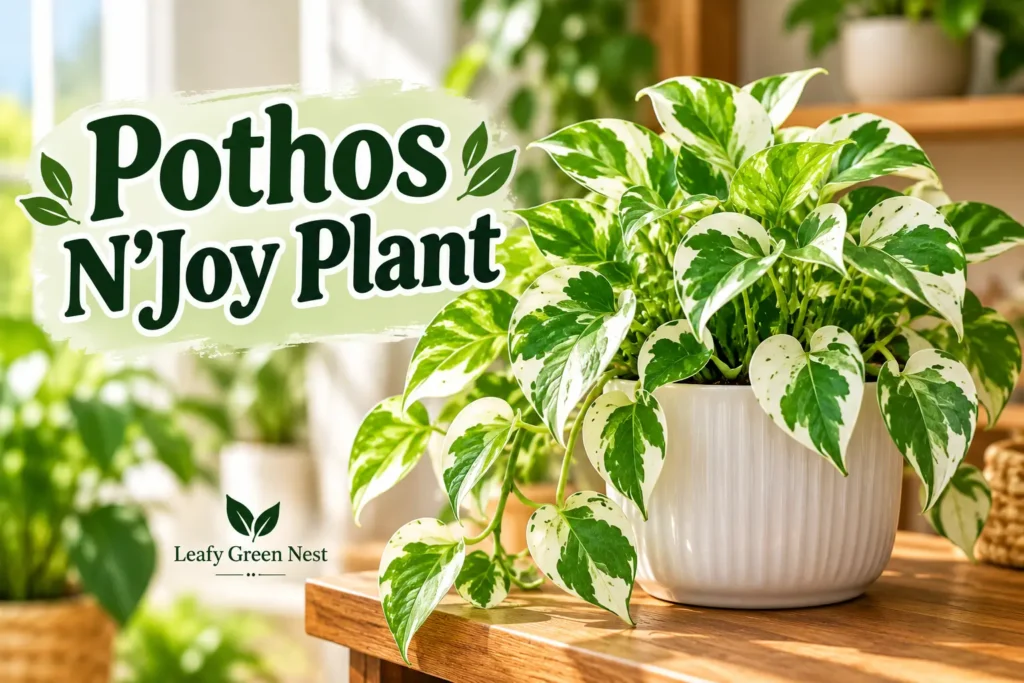
The Pothos N’Joy plant is a beautiful, compact houseplant known for its green leaves and crisp white variegation. It is a popular choice for shelves, desks, hanging baskets, and small indoor gardens. With the right light, careful watering, and well-draining soil, this plant can thrive indoors without demanding constant attention.
If you are searching for Pothos N Joy plant care, propagation methods, plant benefits, or the differences between N’Joy, Pearls and Jade, and Marble Queen pothos, this guide covers the essentials. You will also learn how to grow a full, healthy plant, solve common problems, and choose the right spot for your pothos.
Table of Contents
What Is a Pothos N’Joy Plant?
The Pothos N’Joy plant is a variegated cultivar of Epipremnum aureum, a tropical evergreen vine in the arum family, Araceae. It has small to medium-sized, heart-shaped leaves with dark green areas and bright white or creamy-white patches.
Unlike the traditional golden pothos, which develops yellow or golden markings, N’Joy has striking white-and-green foliage. Its relatively compact growth and defined leaf patterns make it especially attractive to indoor plant collectors.
The plant is often sold under names such as N’Joy pothos, N Joy pothos, and Pothos N’Joy. Although the common name contains “pothos,” the plant belongs to the genus Epipremnum, not the true genus Pothos.
Pothos N Joy Plant Care: Essential Growing Conditions
Pothos N Joy plant care is simple once you understand its main needs. The plant prefers filtered light, evenly spaced watering, and soil that allows excess water to drain away.
| Care requirement | Best conditions |
|---|---|
| Scientific name | Epipremnum aureum ‘N’Joy’ |
| Light | Bright, indirect light |
| Watering | When the top 1 to 2 inches of soil dry |
| Soil | Loose, well-draining potting mix |
| Temperature | About 65–85°F (18–29°C) |
| Humidity | Average indoor humidity; moderate to high is welcome |
| Fertilizer | Balanced houseplant fertilizer during active growth |
| Growth habit | Compact, trailing evergreen vine |
| Propagation | Stem cuttings with nodes |
| Pet safety | Toxic if chewed or eaten by cats, dogs, or people |
Light Requirements
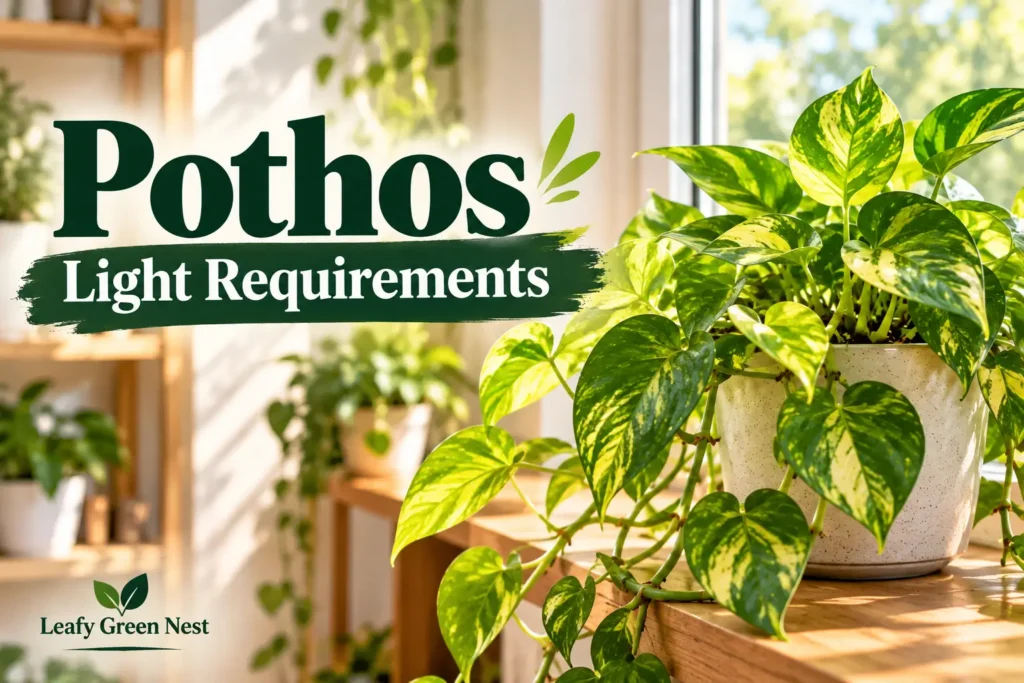
Bright, indirect light is the best choice for a Pothos N’Joy plant. Place it near an east-facing window or a few feet from a bright south- or west-facing window, depending on the strength of the sunlight.
The white parts of its leaves contain less chlorophyll than the green parts. This means the plant benefits from good light to support healthy growth and maintain its variegated appearance.
How to provide the right light:
- Place the plant in bright, filtered daylight.
- Use a sheer curtain if direct sunlight reaches the leaves.
- Rotate the pot occasionally for more even growth.
- Consider a grow light if your room receives very little daylight.
What happens in low light? The plant may grow slowly, produce longer gaps between leaves, and develop more green foliage. Too much direct afternoon sunlight can scorch the leaves and create dry, brown patches.
Expert tip: If your N’Joy loses its white markings, improve the light gradually rather than moving it straight into strong sunlight.
Watering Requirements
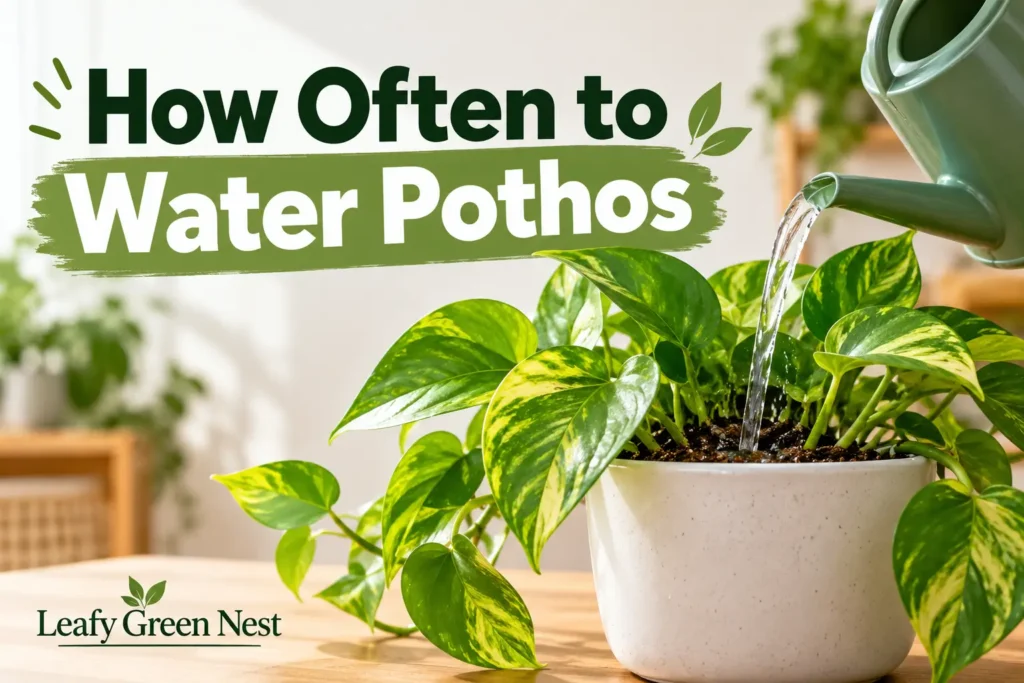
Water your N’Joy pothos when the top 1 to 2 inches of soil feel dry. The exact watering frequency depends on the season, pot size, temperature, light exposure, and soil mix.
There is no universal watering schedule that works for every plant.
Follow these steps:
- Insert your finger into the top layer of soil.
- If the soil feels dry, water slowly and thoroughly.
- Allow excess water to flow through the drainage holes.
- Empty the saucer so the pot does not sit in standing water.
- Check the soil again before the next watering.
In warm, bright conditions, the plant may need water more often. During cooler months or periods of slower growth, it usually needs less.
Signs of watering problems
| Symptom | Possible cause | What to do |
|---|---|---|
| Yellow leaves and wet soil | Overwatering | Let the soil dry and check the roots |
| Drooping leaves and dry soil | Underwatering | Water thoroughly |
| Brown, crispy leaf edges | Dry air, inconsistent watering, or salt buildup | Check moisture and review care conditions |
| Yellow leaves with soft stems | Possible root rot | Inspect roots and remove damaged tissue |
Avoid watering just because the surface looks dry. The soil beneath the surface may still be wet.
Best Soil for Pothos N’Joy
A loose, well-draining potting mix helps prevent root rot and gives the roots access to oxygen.
A simple mix for indoor growing includes:
- Two parts good-quality indoor potting mix
- One part perlite
- One part fine orchid bark or another chunky aeration material
You can adjust the proportions depending on your home environment and how quickly the mix dries. If you prefer a ready-made option, choose an indoor aroid mix designed for pothos, philodendrons, and similar tropical plants.
Avoid dense garden soil in indoor pots. It can compact easily and hold too much water.
Do you need a special pot? No. A plastic, terracotta, or ceramic pot can work as long as it has drainage holes. Terracotta dries faster, while plastic generally retains moisture longer.
Temperature and Humidity
Pothos N’Joy prefers warm indoor conditions, ideally around 65–85°F (18–29°C). Protect it from cold drafts, freezing temperatures, and sudden changes in temperature.
Average household humidity is usually adequate. Moderate humidity can encourage healthy foliage, but you do not need to create a tropical greenhouse for this plant.
Helpful tips:
- Keep the plant away from heating vents and strong air-conditioning drafts.
- Avoid placing it against a cold window during winter.
- Group it with other houseplants if you want to create a slightly more humid microclimate.
- Use a humidifier if your indoor air is consistently very dry.
Misting is not essential. It provides only a short-lived increase in surface moisture and does not replace proper watering or suitable growing conditions.
Fertilizer and Feeding
Feed your Pothos N’Joy with a balanced liquid houseplant fertilizer during active growth, usually spring and summer. Follow the label directions and avoid applying concentrated fertilizer to dry roots.
A practical feeding routine is:
- Begin with a diluted dose if the plant is sensitive or newly purchased.
- Feed periodically during active growth according to the product label.
- Reduce or stop feeding when growth slows in winter.
- Flush the soil with plain water occasionally if mineral salts accumulate.
Too much fertilizer can damage roots and cause brown leaf tips. A plant that is not growing may also need more light, a healthier root system, or fresh soil rather than additional fertilizer.
How to Propagate Pothos N Joy Plant
Pothos N Joy plant propagation is usually done with stem cuttings. It is an affordable way to create new plants, fill out an existing pot, or share cuttings with friends.
The key is to include a node, the small point on a stem where a leaf and aerial root can emerge. A leaf without a node will not normally grow into a complete new vine.
Method 1: Propagating in Water
Step 1: Take a healthy cutting
Choose a healthy stem and use clean scissors to cut just below a node. Include at least one node and, ideally, one or two leaves.
Step 2: Place the node in water
Put the cutting in a clean glass of water. Keep the node submerged but leave the leaves above the waterline.
Step 3: Wait for roots
Keep the glass in bright, indirect light. Refresh the water when it becomes cloudy and watch for healthy new roots over the following weeks.
Step 4: Transfer to soil
Once the roots are well developed, plant the cutting in a small pot with drainage holes. Keep the mix lightly moist while the cutting adjusts.
Rooting often takes a few weeks, although conditions can make the process faster or slower.
Method 2: Propagating Directly in Soil
You can also root N’Joy cuttings directly in potting mix. This method avoids moving water-grown roots into soil, but you will not be able to see the roots as they develop.
- Take a cutting with at least one node.
- Place the node into a moist, well-draining mix.
- Keep the soil lightly moist, not waterlogged.
- Provide bright, indirect light and warmth.
- Check for new growth over the following weeks.
Propagation tip: Take several cuttings and plant them together after rooting. This can help create a fuller-looking Pothos N’Joy plant rather than a pot with only one long vine.
For more detailed advice on growing pothos indoors, see the North Carolina State University Extension guide to Epipremnum aureum.
N Joy Pothos Benefits for Indoor Spaces
The main N Joy pothos benefits include attractive foliage, manageable care needs, and flexible placement around the home. It can bring natural color to a room without requiring a complicated care routine.
1. Attractive Indoor Decoration
Its white-and-green leaves add contrast to shelves, desks, bedrooms, and living rooms. The compact growth habit is useful when you want a variegated plant without the large footprint of a mature climbing vine.
2. Suitable for Beginners
The plant does not need daily care, complicated pruning, or frequent feeding. Once you learn to judge soil moisture and provide suitable light, its routine is straightforward.
3. Flexible Growing Styles
You can grow it in a hanging basket, let the stems trail from a shelf, or train the vine upward on a suitable support. Regular pruning can help maintain a compact shape.
4. Possible Indoor Air Benefits
Pothos is often marketed as an air-purifying houseplant. Research has examined how plants remove certain volatile compounds in controlled environments, but those findings should not be confused with proven air-cleaning performance in an ordinary home.
A few houseplants should not replace ventilation, source control, or a suitable air purifier when indoor air quality is a concern.
5. A Plant You Can Share
Stem cuttings make it easy to propagate additional plants. You can use them to fill another pot or give a rooted cutting to someone who wants to start a houseplant collection.
Safety reminder: N’Joy pothos contains insoluble calcium oxalate crystals. Chewing or swallowing it can cause mouth pain, swelling, drooling, and digestive upset. Keep the plant out of reach of children and pets.
N Joy Pothos vs Pearls and Jade: Key Differences
N’Joy pothos and Pearls and Jade pothos look similar because both have green-and-white variegated leaves. However, their leaf patterns provide useful clues for identification.
| Feature | N’Joy pothos | Pearls and Jade pothos |
|---|---|---|
| Leaf pattern | Clear, defined green and white patches | More irregular white, green, and gray-green markings |
| White areas | Often clean and distinct | Often mixed with speckles and mottling |
| Appearance | Crisp, high-contrast foliage | More textured, speckled foliage |
| Growth | Compact, generally slow to moderate | Compact, generally slow-growing |
| Light | Bright, indirect light | Bright, indirect light |
| Best feature | Clean, bold variegation | Detailed, multicolored leaf patterns |
Pearls and Jade is a distinct cultivar. Its foliage often features white and silvery-gray areas alongside green markings. N’Joy is generally recognized by its more clearly defined blocks of white and green.
Which one should you choose? Choose N’Joy if you prefer cleaner, high-contrast leaf patterns. Choose Pearls and Jade if you like smaller, more intricately marked leaves.
N Joy Pothos vs Marble Queen: Which Looks Better?
Marble Queen pothos is another popular white-variegated cultivar. It differs from N’Joy mainly in its leaf pattern and overall appearance.
| Feature | N’Joy | Marble Queen |
|---|---|---|
| Variegation | Defined white and green patches | Creamy-white marbling throughout the leaves |
| Leaf appearance | Usually smaller and more compact | Often broader-looking, depending on growing conditions |
| Visual effect | Strong contrast | Soft, marbled appearance |
| Growth | Often slower and compact | Can grow more vigorously under favorable conditions |
| Care | Bright, indirect light and well-draining soil | Similar care, with good light needed to maintain variegation |
Neither cultivar is automatically better. Your choice depends on the leaf pattern you prefer and the growing conditions you can provide.
Pothos N Joy Scientific Name and Plant Identification
The Pothos N Joy scientific name is Epipremnum aureum ‘N’Joy’. It belongs to the Araceae family and is grown mainly for its attractive, variegated foliage.
The plant has heart-shaped leaves, green sections, and creamy-white areas. Its compact growth and distinct leaf markings help separate it from other pothos cultivars.
How to Identify a True N’Joy Pothos
Look for these features when identifying the plant:
- Leaf color: Clear white or creamy-white sections mixed with green.
- Leaf pattern: Usually distinct patches rather than fine marbling throughout the leaf.
- Growth habit: Compact, trailing stems with relatively small leaves.
- Variegation: White areas may vary between leaves and stems.
Leaf patterns can change with growing conditions. Young plants may also look different from mature specimens, so consider several leaves instead of relying on one leaf for identification.
Pothos N Joy Full Grown: Size and Growth Rate
A Pothos N Joy full grown plant can develop long trailing stems, but it usually retains a relatively compact appearance compared with more vigorous pothos cultivars. Its final size depends on light, root space, temperature, nutrition, pruning, and whether it grows downward or climbs a support.
How to Encourage Fuller Growth
- Give it enough bright, indirect light.
- Prune excessively long or bare stems.
- Root healthy cuttings and plant them back into the same pot.
- Repot when the roots become crowded.
- Avoid overwatering, which can damage roots and slow growth.
N’Joy can look sparse if it receives too little light or loses leaves along older stems. Pruning and replanting healthy cuttings are practical ways to improve its appearance.
Does Pothos N’Joy Grow Fast?
It is generally a slow-to-moderate grower, especially compared with vigorous green pothos varieties. Its white leaf areas contain less chlorophyll, so highly variegated foliage has less green tissue available for photosynthesis.
With suitable light, warmth, and healthy roots, it can produce new leaves throughout the active growing season. Growth usually slows when light levels drop or temperatures become cooler.
Pothos N Joy Plant for Sale: What to Check Before Buying
You can often find a Pothos N Joy plant for sale at local nurseries, garden centers, specialist houseplant shops, and online plant stores. Availability and prices vary by location, plant size, and season.
If you are buying a plant, inspect it carefully before bringing it home.
Buying Checklist
- Look for clearly defined green-and-white leaves.
- Check the undersides of leaves and the stem joints for pests.
- Avoid plants with widespread yellowing or soft, blackened stems.
- Check that the soil is not constantly waterlogged.
- Choose a plant with several healthy stems if you want a fuller appearance.
- Confirm that the seller has labeled the cultivar correctly.
- Check the pot size, shipping conditions, and return policy for online orders.
A small plant is often a good starting point because you can watch it adapt to your home and grow over time. A larger plant offers a more immediate decorative effect, but it may cost more.
For online purchases, compare the seller’s actual plant photos with the listing description. Stock photos can make it difficult to judge the plant’s size, fullness, and condition.
Common Pothos N’Joy Problems and How to Fix Them
Most problems with N’Joy pothos come from watering errors, unsuitable light, or pests. Check the growing conditions before assuming the plant needs fertilizer or a new pot.
Possible cause: overwatering, poor drainage, or natural aging.
Check the soil and roots. If the soil stays wet, let it dry appropriately and inspect for root rot. Remove badly damaged leaves.
Leaves turning greener
Possible cause: insufficient light.
Move the plant to a brighter spot with indirect light. Prune fully green growth if you want to encourage a more balanced appearance.
Brown leaf tips or edges
Possible cause: inconsistent watering, mineral buildup, direct sun, or dry air.
Review watering habits, move the plant away from harsh sunlight, and flush excess fertilizer salts from the soil when appropriate.
White cottony patches or sticky leaves
Possible cause: mealybugs or other sap-feeding pests.
Isolate the plant, inspect leaf joints and undersides, and treat the infestation with a product labeled for indoor plants. Repeat inspections to catch returning pests.
Other problems can include root rot, leaf scorch, and slow growth. Root rot is especially likely when the pot lacks drainage or the soil stays saturated.
Expert Tips for Growing a Healthy N’Joy Pothos
Small adjustments can make a noticeable difference in the health and appearance of your plant. Use these practical habits to maintain attractive foliage and encourage steady growth.
- Prioritize light over fertilizer. Good indirect light supports healthy growth and helps preserve the white markings.
- Use the soil, not the calendar, to decide when to water. This reduces the risk of root rot.
- Prune with a purpose. Cut back long, bare stems to encourage a tidier shape and use healthy cuttings to fill the pot.
- Repot only when needed. Move the plant to a slightly larger pot when its roots become crowded or watering becomes unusually difficult.
- Clean the leaves gently. Wipe away dust with a soft, damp cloth so the foliage stays clean.
- Inspect new plants before grouping them with others. This helps prevent pests from spreading through your houseplant collection.
- Keep the plant away from pets and young children. Its tissues can cause irritation if chewed or swallowed.
Is the Pothos N’Joy Plant Worth Growing in Your Home?
The Pothos N’Joy plant is an excellent choice if you want a compact houseplant with striking white-and-green foliage. It offers an attractive alternative to golden pothos and Marble Queen, especially if you prefer sharply defined leaf patterns.
Its care routine is simple: provide bright, indirect light, water when the upper soil layer dries, use a well-draining mix, and prune as needed. Pay attention to its leaves and roots, and adjust care as the seasons change.
Although it is easy to grow, N’Joy is not completely maintenance-free. It needs suitable light to maintain its variegation and should be protected from overwatering and pests. Keep it away from pets and children who might chew the leaves.
With these basic habits, you can enjoy a healthy N’Joy pothos for years and propagate new plants whenever its vines grow long enough.
Frequently Asked Questions
What is the scientific name of the Pothos N’Joy plant?
The scientific name is Epipremnum aureum ‘N’Joy’. It is a cultivated variety of pothos grown for its compact growth and distinctive white-and-green variegated leaves.
Is Pothos N’Joy a good indoor plant?
Yes. Pothos N’Joy is well suited to indoor growing because it needs relatively little maintenance. It does best with bright, indirect light, a well-draining potting mix, and careful watering.
Can Pothos N’Joy grow in water permanently?
Yes, it can grow in water when provided with suitable light and regular water changes. However, water-grown plants need an appropriate nutrient supply, and growth may differ from that of plants grown in potting mix.
Should I cut off fully green leaves on my N’Joy pothos?
You do not need to remove every green leaf. If a stem produces only green leaves and you want to maintain strong variegation, prune that stem back to a section with the desired pattern.
Why is my Pothos N’Joy growing slowly?
Slow growth can result from insufficient light, cool temperatures, root problems, nutrient shortages, or the plant’s naturally compact growth habit. Check the roots and growing conditions before adding fertilizer.
Does Pothos N’Joy need a moss pole?
No. You can grow it in a hanging basket or let its stems trail from a shelf. A support is optional if you want to train the plant to climb, but it is not required for healthy growth.