
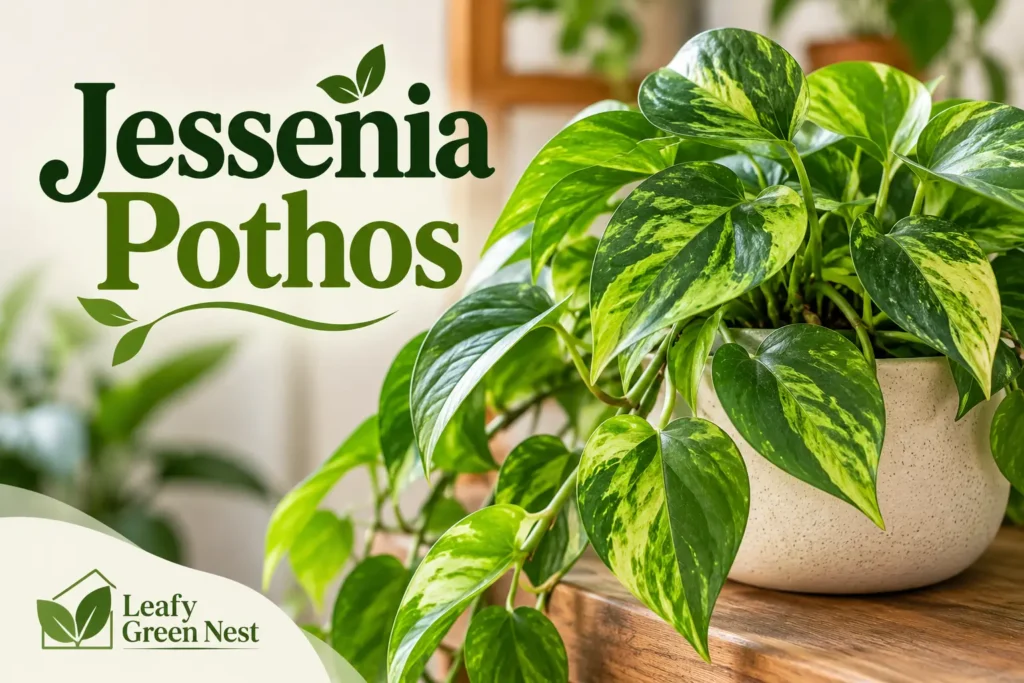
Jessenia Pothos is a tropical houseplant with heart-shaped leaves patterned in shades of green and lime green. It is a good choice for people who want attractive foliage without a complicated care routine. With suitable light, well-draining soil, and careful watering, this trailing vine can grow well in many homes.
This guide covers Jessenia Pothos care, propagation, common problems, plant safety, price factors, and buying tips. You will also learn how to distinguish it from Marble Queen and Neon Pothos and how to choose a healthy plant online.
Table of Contents
What Is Jessenia Pothos?
Jessenia Pothos is a cultivated variety of Epipremnum aureum, a tropical evergreen vine commonly grown indoors. Its main identifying feature is its green foliage with lighter lime-green markings, although the pattern varies between leaves.
The plant can trail from a hanging basket or shelf. It can also climb a support if you prefer an upright display. Its care needs are similar to those of other common pothos varieties.
| Feature | Details |
|---|---|
| Botanical species | Epipremnum aureum |
| Common name | Jessenia Pothos |
| Plant type | Tropical evergreen vine |
| Leaf shape | Heart-shaped |
| Leaf color | Green with lime-green markings |
| Ideal light | Bright, indirect light |
| Watering | Water when the upper soil has dried sufficiently |
| Soil | Loose, well-draining potting mix |
| Growth habit | Trailing or climbing |
| Propagation | Stem cuttings with a node |
| Pet safety | Toxic to cats and dogs if chewed or eaten |
Identification tip: A plant’s name on a listing does not guarantee its identity. If the exact variety matters to you, ask for recent photographs of the actual plant rather than relying only on a stock image.
Jessenia Pothos Care: Light, Water, and Soil
Jessenia Pothos is generally easy to grow indoors when its basic needs are met. Bright, indirect light supports healthy growth, while careful watering and an airy potting mix help prevent root problems.
Light Requirements for Jessenia Pothos
Bright, indirect light is usually best for Jessenia Pothos. Place it near a bright window where it receives plenty of daylight without prolonged exposure to intense direct sun.
- Best location: Near an east-facing window or a short distance from a bright south- or west-facing window.
- Low light: The plant may survive, but growth can slow and new leaves may show less contrast.
- Harsh direct sunlight: Strong sun can scorch the leaves.
- Grow lights: A suitable grow light can help in rooms with limited natural light.
If new leaves become less colorful, check the plant’s light conditions before changing its watering routine. Move it gradually if it needs more light, and monitor new growth rather than expecting older leaves to change completely.
Watering Jessenia Pothos
Water Jessenia Pothos when the upper layer of soil has dried. The right interval depends on light, temperature, pot size, and the type of potting mix, so a fixed weekly schedule is unreliable.
Follow these steps:
- Check the upper 1 to 2 inches of soil.
- If that layer is dry, check whether the deeper soil remains very wet.
- Water thoroughly when needed, allowing excess water to drain through the pot.
- Empty the saucer so the roots do not sit in standing water.
- Check the soil again before the next watering.
A plant in a small pot near a bright window may dry much faster than one in a large pot in a cool room.
| Symptom | Possible cause | What to check |
|---|---|---|
| Yellow leaves and wet soil | Overwatering or poor drainage | Soil moisture and root condition |
| Drooping leaves and dry soil | Underwatering | Whether the root ball is dry |
| Brown, crispy edges | Dry soil, fertilizer buildup, or dry air | Watering and feeding habits |
| Soil remains wet for days | Dense mix or poor drainage | Pot holes, soil texture, and pot size |
| One older leaf turns yellow | Natural aging or a care issue | Whether other leaves are affected |
Do not assume every yellow leaf means overwatering. Look at the soil, roots, and overall growth before deciding what to change.
Best Soil for Jessenia Pothos
Jessenia Pothos needs soil that retains some moisture while allowing excess water to drain. Dense, soggy soil can reduce oxygen around the roots and increase the risk of root rot.
A practical starting mix is:
- Two parts general indoor potting mix
- One part perlite
- One part fine orchid bark
Adjust the mix to your growing conditions. A pot with drainage holes is essential; stones placed at the bottom cannot replace proper drainage.
For general growing guidance, read the University of Wisconsin-Madison Extension guide to pothos. It covers broad pothos care and propagation rather than testing the Jessenia cultivar specifically.
Temperature and Fertilizer
Jessenia Pothos generally grows well at normal indoor temperatures. A range of about 65°F to 85°F (18°C to 29°C) is a useful target. Protect it from cold drafts and sudden temperature changes.
During active growth, use a balanced liquid houseplant fertilizer according to the label. Excess fertilizer can damage roots and contribute to brown leaf edges. Reduce or pause feeding when growth slows in winter.
If your plant has just arrived by mail or has recently been repotted, let it adjust before fertilizing. A stressed plant needs stable conditions more than extra nutrients.
Pruning and Repotting Jessenia Pothos
Pruning controls vine length and can help create a fuller appearance. Use clean scissors to cut just above a leaf node. Healthy cuttings with nodes can be used for propagation.
Repot when roots fill the container, circle the root ball, or emerge through drainage holes. Choose a pot only slightly larger than the existing one. A much larger pot can hold excess moisture for too long.
How to Propagate Jessenia Pothos
You can propagate Jessenia Pothos from a stem cutting that includes at least one node. A node is the point on the stem where a leaf or aerial root develops. A leaf without a node will not normally grow into a new vine.
Propagating Jessenia Pothos in Water
- Select a healthy stem with at least one node.
- Cut just below the node with clean scissors.
- Remove any leaves that would sit underwater.
- Place the node in a clean container of water.
- Keep the cutting in bright, indirect light.
- Replace cloudy water and top it up as needed.
- Transfer the cutting to potting mix once it has developed a healthy root system.
Rooting time varies with warmth, light, and cutting health. Look at root development rather than following a strict deadline.
Propagating Jessenia Pothos in Soil
You can also place a node-bearing cutting directly into a lightly moist, airy potting mix. Keep the mix slightly moist while roots develop, but avoid leaving it saturated.
To make an established plant look fuller, you can root several cuttings and grow them together in one pot. Make sure the container has enough room for the combined root systems.
Jessenia Pothos vs Marble Queen: Key Differences
Jessenia Pothos and Marble Queen are varieties of the same species, but their leaf patterns usually look different. Jessenia has green-on-green markings, while Marble Queen typically has green leaves with cream or white areas.
| Feature | Jessenia Pothos | Marble Queen Pothos |
|---|---|---|
| Main colors | Green and lime green | Green and cream or white |
| Typical pattern | Green-on-green markings | Pale marbling |
| Overall appearance | Layered green tones | Lighter, higher-contrast foliage |
| Light needs | Bright, indirect light | Bright, indirect light |
| Care difficulty | Generally easy | Generally easy |
| Best for | A green-toned display | A lighter, marbled display |
Both varieties need well-draining soil and careful watering. Marble Queen’s pale leaf areas contain less chlorophyll than green tissue, so suitable light is helpful for healthy growth. Strong direct sunlight can damage either variety.
Leaf patterns naturally vary. When shopping, compare several leaves and check whether the listing shows the actual plant.
Jessenia Pothos vs Neon Pothos: Which Should You Choose?
Jessenia Pothos usually has mixed green and lime-green markings. Neon Pothos generally has more uniform bright chartreuse or yellow-green leaves.
Choose Jessenia if you prefer a patterned look. Choose Neon if you want bright foliage with a more consistent color.
| Feature | Jessenia Pothos | Neon Pothos |
|---|---|---|
| Leaf color | Mixed green tones | Bright chartreuse |
| Pattern | Variegated | Usually more uniform |
| Visual effect | Subtle color variation | Bold, bright color |
| Care needs | Bright indirect light and careful watering | Bright indirect light and careful watering |
| Best for | Patterned foliage | A vivid color accent |
Plant names used by sellers are not always consistent. If a listing uses a name such as “Neon Queen,” ask for the botanical name and recent photos before purchasing.
Is Jessenia Pothos Rare?
Jessenia Pothos may be harder to find than Golden Pothos in some markets, but availability depends on location, season, nursery supply, and plant size. A variety that is uncommon in one area may be readily available elsewhere.
Rarity claims alone do not establish a plant’s value. Before paying a premium, check the plant’s identity, condition, and total cost.
Look for:
- Clear photos of the actual plant
- Firm stems and healthy leaves
- A visible green-on-green leaf pattern
- Accurate information about size and rooting
- Reasonable shipping and return terms
- Comparable listings from reputable sellers
A correctly identified, healthy plant is generally a better purchase than a stressed plant marketed as rare.
Jessenia Pothos Benefits for Indoor Spaces
The main benefit of Jessenia Pothos is its decorative foliage. Its trailing stems and patterned leaves work well in hanging baskets, on shelves, or around a climbing support.
Decorative Appeal
The lime-green markings add contrast while keeping an overall green appearance. This makes Jessenia a useful option for people who want patterned foliage without the cream or white sections found in some other pothos varieties.
Flexible Growth and Easy Propagation
The plant can trail naturally or climb with support. Pruning helps manage its shape, and stem cuttings allow you to grow additional plants from a healthy parent.
Propagation can reduce the need to buy several plants, although new cuttings need time to root and establish themselves.
Does Jessenia Pothos Purify Indoor Air?
Jessenia Pothos should not be treated as a practical substitute for indoor air filtration. Some laboratory studies have found that plants can remove certain airborne chemicals under controlled conditions, but those findings do not mean a few houseplants can clean the air in an ordinary home.
A review by Cummings and Waring found that the pollutant-removal rate of ordinary potted plants is too low to compete with typical building air exchange. Read the published review on potted plants and indoor air quality.
Enjoy Jessenia for its foliage and the experience of growing a plant. For indoor air quality, prioritize suitable ventilation and appropriate filtration.
Is Jessenia Pothos Safe for Pets?
No. Pothos is toxic to cats and dogs if chewed or eaten. The ASPCA identifies Epipremnum aureum as toxic because it contains insoluble calcium oxalate crystals. These can cause oral irritation, drooling, vomiting, and difficulty swallowing.
Keep the plant and fallen cuttings out of pets’ reach. A hanging basket can reduce access, but it does not guarantee safety.
If a pet chews the plant and develops symptoms, contact a veterinarian. See the ASPCA’s Golden Pothos toxicity reference for more information.
Buy Jessenia Pothos: How to Choose a Healthy Plant
When you buy Jessenia Pothos, check its health, identity, size, and shipping conditions. A strong leaf pattern is appealing, but healthy stems and roots matter more for long-term growth.
Use this checklist before placing an order:
- Leaves: Look for firm leaves with green-on-green markings.
- Stems: Avoid stems that are mushy, blackened, or badly shriveled.
- Pests: Check leaf undersides, stems, and leaf joints for insects, webbing, or sticky residue.
- Size: Confirm whether the listing is for a cutting, starter plant, or established plant.
- Photos: Request current pictures if the listing uses generic images.
- Pot: For a potted plant, check that the container has drainage holes.
- Shipping: Review delivery estimates, packaging, and the policy for transit damage.
- Total cost: Include shipping, taxes, and other fees before comparing sellers.
A cutting is often less expensive, but it needs rooting and growing time. An established plant costs more because it already has roots and visible growth.
Jessenia Pothos for Sale: What Affects the Price?
Jessenia Pothos prices vary according to plant size, maturity, seller, local availability, shipping costs, and demand. There is no single price that applies to every retailer or country.
| Plant type | Main price factors | What to check |
|---|---|---|
| Single cutting | Node count, health, seller | Confirm that it includes a usable node |
| Small rooted plant | Root development and leaf count | Check whether it is established in soil |
| Established potted plant | Size, fullness, and pot | Compare plant dimensions and condition |
| Large specimen | Vine length and number of stems | Request photos of the actual plant |
| Imported plant | Shipping and applicable import requirements | Check local rules and total delivered cost |
Treat old price lists and social media posts as rough references, not current market quotes. Prices change, and listings may describe very different plants.
Compare the total delivered cost and the seller’s plant-health policy. A low advertised price may refer to a small cutting or exclude shipping.
Jessenia Pothos Live Plant: What to Check Before Delivery
Buying a Jessenia Pothos live plant online is convenient, but shipping can expose it to darkness, temperature changes, and movement. Check the seller’s packing and delivery terms before ordering.
Confirm the following details:
- Is the plant rooted in soil or shipped bare-root?
- Does the listing show the actual plant?
- Is the pot included?
- How is the plant protected during shipping?
- What happens if it arrives severely damaged?
- Is delivery available to your address?
When the plant arrives, unpack it promptly and inspect the leaves, stems, and soil. Keep it separate from other houseplants while you check for pests. Give it bright, indirect light and avoid immediate heavy pruning or fertilizing.
A few damaged leaves may occur during transit. Pay closer attention to stem health, root condition where visible, and whether the plant begins adjusting to its new environment.
Jessenia Pothos Costa Farms: Availability and Buying Tips
Costa Farms is a large commercial plant grower, but its available varieties depend on the retailer, region, and season. Finding an old product page or search result does not guarantee that Jessenia Pothos is currently in stock.
If you find a Jessenia Pothos Costa Farms listing, confirm the plant name, pot size, price, stock status, and delivery terms with the retailer. Check whether shipping is included and whether the seller has a policy for plants damaged in transit.
Do not assume that every store selling Costa Farms plants carries every variety. Compare the actual listing and purchase terms instead of relying on the grower’s name alone.
Common Jessenia Pothos Problems and Solutions
Most Jessenia Pothos problems relate to watering, light, root health, pests, or changes in growing conditions. Check the soil and plant carefully before trying multiple treatments.
| Problem | Possible cause | Practical response |
|---|---|---|
| Yellow leaves | Overwatering, poor drainage, or natural aging | Check soil moisture and inspect roots if several leaves are affected |
| Brown, crispy edges | Dry soil or fertilizer buildup | Review watering and feeding |
| Greener new leaves | Low light or natural variation | Provide brighter indirect light and monitor new growth |
| Long, sparse vines | Insufficient light | Improve light and prune leggy growth |
| Drooping leaves | Soil too dry or roots too wet | Check soil before watering |
| Slow growth | Low light, seasonal slowdown, or root issues | Review light and root condition |
| Fine webbing or tiny insects | Possible pest infestation | Isolate the plant and identify the pest |
Why Is My Jessenia Pothos Turning Green?
Jessenia Pothos may develop less contrasting leaves when it receives too little light. Move it gradually to a brighter location with indirect light and observe its next leaves.
Older leaves may not change their pattern completely after a move. Natural variation also occurs, so assess several new leaves instead of judging the plant by one leaf.
Why Are My Jessenia Pothos Leaves Turning Yellow?
Yellow leaves can result from overwatering, poor drainage, root damage, or natural aging. If several leaves turn yellow while the soil remains wet, check whether the pot drains properly.
Soft, dark, or foul-smelling roots may indicate root rot. Remove clearly damaged roots with clean tools and repot into fresh, airy mix if needed. Do not water again until the soil and plant condition indicate that it is necessary.
How Can You Fix Leggy Growth?
Leggy growth often means the plant is reaching for more light. Move it to a brighter location with indirect light, then trim long stems if you want a fuller shape.
Healthy cuttings can be rooted and planted back into the pot after they establish roots. Pruning alone will not solve the problem if the plant remains in a dark location.
Expert Tips for Growing Fuller Jessenia Pothos
A fuller plant usually comes from consistent light, healthy roots, and selective pruning, not from extra fertilizer or frequent watering.
- Prioritize light: Provide bright, indirect light for healthy growth.
- Check before watering: Use soil moisture rather than a weekly schedule.
- Prune strategically: Trim long vines above a node.
- Reuse cuttings: Root healthy cuttings and add them to the pot when established.
- Clean the leaves: Gently remove dust from the foliage.
- Inspect new plants: Check for pests before placing a new plant near your collection.
- Avoid excess fertilizer: Follow label directions and reduce feeding when growth slows.
- Use a suitable pot: Choose drainage holes and a container that fits the root system.
- Change one thing at a time: Adjust the most likely cause of a problem and monitor the response.
These simple habits make plant care easier and help you spot problems before they become severe.
Is Jessenia Pothos Worth Growing? Care and Buying Tips
Jessenia Pothos is a good option if you like trailing houseplants with green and lime-green foliage. It is generally manageable for beginners, can be propagated from stem cuttings, and suits shelves, hanging baskets, and climbing supports.
Its main drawbacks are that poor light may reduce leaf contrast, seller identification can be inconsistent, and the plant is toxic to cats and dogs if eaten. It should not be purchased as a substitute for proper air filtration.
Before buying, compare the plant’s health, size, identification, and total delivered cost. Once it arrives, focus on bright indirect light, well-draining soil, and watering based on soil moisture. Consistent care is more useful than expensive products or complicated routines.
Frequently Asked Questions
What is Jessenia Pothos?
Jessenia Pothos is a cultivated variety of Epipremnum aureum with heart-shaped leaves featuring green and lime-green markings.
Is Jessenia Pothos easy to care for?
Yes. It generally grows well indoors with bright, indirect light, well-draining soil, and watering when the upper soil layer dries.
How often should you water Jessenia Pothos?
Water when the upper 1 to 2 inches of soil feel dry. Adjust the frequency based on light, temperature, pot size, and soil moisture.
Can you propagate Jessenia Pothos in water?
Yes. Take a healthy stem cutting with at least one node, place the node in water, and provide bright, indirect light until roots develop.
Is Jessenia Pothos toxic to pets?
Yes. Jessenia Pothos is considered toxic to cats and dogs if chewed or eaten because pothos contains insoluble calcium oxalate crystals.
Why is Jessenia Pothos sometimes expensive?
Its price depends on availability, plant size, maturity, seller, and shipping costs. Compare the plant’s health and total delivered price before buying.


